This history piece will illustrate his struggle to break that isolation and lead the Republic into political and diplomatic maturity. As you shall witness many changes happened during his government that will have a lasting effect in the Somali political life. For example the major SYL party crumbled and broke up. Prominent members were either expelled or left the Party on their own and in their place took new members who were merely driven self interest. The political and constitutional crisis generated in this era spilled into the 1969 election and as a result the military coup.
The 1964 General Elections
On April 3rd the results were announced as follows:
Somali Youth League (SYL) won 69 seats; Somali National Congress (SNC) won 22 seats; Somali Democratic Union (SDU) won 15 seats; Somali Independent Constitutional Party (HDMS) won 9 seats; Other small political Parties shared 8 seats. (1)
The SYL for the first time gained 12 seats in the Northern Regions and the opposition SNC took 11 seats in the Southern Regions. The Somali Youth League held 83 seats in the last parliament. Neither the SNC nor the SDU were then established as political parties.
When the results were officially announced, 12 deputies from various parties crossed the line and joined the Somali Youth League Party bringing the total number of SYL deputies an absolute majority of 81deputies.
The first business of the National Assembly when it convened for the first time in May the 27th was to elect a speaker. The Assembly unanimously elected Deputy Ahmed Sh. Mohamed Absiye a deputy from Berbera as president of the Somali National Assembly.
Two weeks after, the President of the Republic Aden Abdulle Osman speaking about the recent general elections in the country said in a broadcast: "logically, not everyone can be satisfied because there are clashes of many interests, and this may have been the cause of the nation not being completely satisfied and happy. There is one thing which requires to be considered, and that is that an aggrieved man will achieve nothing through force. If anyone feels that he is being denied his rights, there is a system in place - he should appeal to the Supreme Court and await its verdict. It is fruitless to arouse passions or incite trouble. (2)
Somali Youth League Party Policy:
Somali Youth League Party enjoying an absolute majority in the National Assembly outlined its policy. In a statement issued the next day it said that the Party and the Government will adopt a positive policy in seeking the liberation and complete re-unification of all Somalis, so that the Somali Nation will come into one unified entity, in accordance with the Constitution of the Republic, which stipulates that the entire Somali Nation should be united under one flag and one parliament.
On foreign policy, the statement said the government to be formed will practice and support positive neutrality and non-alignment in the cold-war struggle. The Party supports the resolutions of the Lagos, Addis Ababa, and Dar-e-Salaam conferences of the OAU.
"We are opposed to imperialism in any form and call for its downfall," the statement said,"Imperialism, which comes in many colors includes the Apartheid policy practiced by the evil fascist government of South Africa, and the merciless imperialism practiced by Portugal in Angola, Mozambique and other enslaved colonies."(3)
New Prime Minister Appointed
In accordance with the constitution, the President of the Republic on June 6, 1964 invited Hon. Abdirizak Haji Hussein, a deputy from Garowe and a member of the SYL party to form a new government. Mr. Abdirizak H. Hussein succeeds Mr. Abdirashid Ali Sharmarke who held office since independence in 1960 till the March 30 General Elections.
In a press conference, the new Prime Minister accepting the invitation said, " I will make an attempt, and if it goes the way I want, very well; otherwise I will resign and give back the honour and the responsibility invested in me…"(4)
SYL Support the New PM:
The executive and parliamentary group of the majority party Somali Youth League issued another statement on June 11, declaring that they support the President of the Republic's decision and that deputy Abdirizak Haji Hussein should become the head of the new government.
"Although we at first proposed that Hon. Abdirashid Ali Sharmarke should become the Prime Minister of the new government," the statement said, "we have decided, however, after considering the present political situation in the republic, to support the President of the republic's decision."(5)
The Prime Minister:
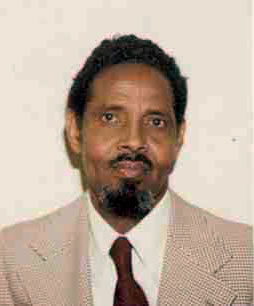
Abdirizak Haji Hussein Hassan was born in the Ethiopian-occupied Haud area in Western Somalia c. 1924. He was educated in the Italian Somaliland. He was a member of the British Army from 1942-47 following the British Military occupation in Italian Somaliland after the war. On the assumption of the Italian Trusteeship in 1950 he was detained as a political prisoner because he was opposed to the return of Italy in Somaliland. He was elected to president of the Somali Youth League in 1955. In 1957, the Italian Administrator in the trust territory of Somaliland under Italian administration appointed Mr. Abdirizak H. Hussein president of the University Institute in Mogadishu. At the Republic's independence in July 1960 he was named Interior Minister; and then following the government reshuffle in November 1962 he become Minister of Public Works and Communications, a post he held until the 1964 general elections.
New Government:
On June 15 Hon. Abdirizak Haji Hussein formed a new government.
Prime Minister - Abdirizak Hagi Hussein. Foreign Affairs - Ahmed Yusuf Dualeh (Deputy from Gabiley) Interior - Abdulkadir Mohamed Adan "Zope" (Deputy from Bur Hakaba) Defence - Adan Issaq Ahmed (Deputy from Borama)* Finance - Awil H. Abdullahi Farah (Deputy from Erigabo) Justice - Ali Omar Shegow (Deputy from Brawe) Health & Labor - Abdullahi Issa Mohamud (Deputy from Beled Weyne) Education - Kenadid Ahmed Yusuf (Deputy from Bardhere) Information - Yusuf Aden Mohamed "Bokah" (Deputy from Erigabo)** Agriculture - Mohamud Issa Jama (Deputy from Hargeisa) Transport & Communications- Sh. Abdulle Mohamud (Deputy from Dhusa Mareb) Commerce and Industry - Osman Mohamud Adde (Deputy from Iskushuban) Somali Affairs - Sh. Mohamud Mohamed Farah "Malingur" (Deputy from Afmadow) (6) * crossed the line from SNC to SYL. ** crossed the line from USP to SYL.
After the ceremony the Prime Minister addressed the new cabinet.
"This government is different from the previous ones because it is new and because it is formed from a new National Assembly. I chose and appoint you as members of the cabinet to run this country on the basis of the ability, qualifications and merits of each one of you, since these are the conditions required for the government to function and prove its capabilities to the Somali nation. I also acted on the authorization given to me by the majority party (SYL) on June 6 to form a government after having judged each man's qualifications and merits. The Party statement indicated the government I was to form has the support of the Party's Parliamentary Group.
It is, I believe, notorious throughout the Somali Republic that once a man becomes a minister, he works for self-interest and ambitions, and for his clan, relatives or constituents. This is irrefutable and all Somalis are aware that there is tribalism in the Somali Republic today, deeply entrenched tribalism fomented by men working for their own interests. Our duty today is to show to all Somalis how we shall stomp out tribalism…
The law and regulations must be above us, since the government – and everyman, no matter what position he holds – must respect and work under the law. If we do this, then there is no doubt that we shall succeed and become a good government and men popular with the masses.
I ask you to declare to me personally and in writing all the property you own before you assume office. This measure would give the public confidence that the government is not working for self-interest, nor that the ministers are disposing of public funds for their own interests or ambitions, but that they are loyal men working for the nation." (7)
Government Fall down:
It is worth noting that only the Prime Minister, Minister of the Interior and Minister of Health and Labour held ministerial posts in the former government. The rest were either new to the National Assembly or never held major posts. Also half of the cabinet members were from the North. In addition, the big portfolios of Foreign, Defence and Finance were allotted to the North. This created a major disagreement among the parliamentary members. In the parliament there were many who believed that the Northern deputies were inexperienced and are incapable of handling such major portfolios.
As a result, on July 14, a vote of no confidence in the newly formed government was passed in the National Assembly by 59 to 57 votes. Accordingly, the Prime Minister Mr. Abdirizak Haji Hussein handed President Aden Abdulle Osman the resignation of his government. The President of the republic asked Mr. Hussein to continue in office until a new Prime Minister is appointed.
SYL punishes party descent:
The Somali youth League Central Committee at a meeting on July the 16th passed a resolution expelling the SYL secretary-general Mr. Yassin Nur Hassan and three other parliamentary members from the party on the grounds that they had refused to abide by the decision of the party which advised members of the parliamentary group to give their vote of confidence to the Prime Minister and his government. The SYL Central Committee on the same day appointed Mr. Mohamed Sh. Gabyow as provincial secretary-general of the Somali Youth League.
Hon. Hussein is re-appointed:
After some house cleaning by the SYL Party, President Aden Abdulle Osman on August 6 again asked Hon. Abdirizak Haji Hussein to form another government. The Prime Minister agreed to the president's request "with reservations." In an interview by Radio Mogadishu, the Prime minister denied rumours that his government failed to secure the vote of confidence because it was pro-western. He re-affirmed that his new government would be one of non-alignment.
Mr. Hussein forms a second government:
The Prime minister appointed his new government on August 31st. The only changes from those announced on June 15 are:
Justice - Abdirahman Haji Mumin. (Deputy from Bulo Burte) Agriculture - Ismail Duale Warsame. (Deputy from Buhodle)* Planning - Ali Omar Shegow. Min. of State - Mohamud Abdi Nur. (Deputy from Baydhabo)** (8)
*crossed the line from SNC to SYL. ** later replaced Sh. Abdulle Mohamoud as Minister of Transport & Communications.
Clearly, the Prime Minister stood firm on his ground and the three challenged portfolios remained unchanged. Deputy Mohamud Isse Jama was sacrificed and two new deputies were added in the cabinet. This second government received a vote of confidence in the National Assembly on September 27 by 91 to 23 votes. Ironically, former Prime Minister, Hon. Abdirashid Ali Sharmarke abstained.
SYL Congress elects a new Secretary- General:
The Somali Youth League Party Congress met on October 30th and elected the Prime Minister Mr. Abdirizak Haji Hussein to be the new Secretary-General of the party. He obtained 125 of the 151 votes cast. This made him at the helm of both the ruling Party and the Government.
Motion to replace the Speaker:
The Somali Parliamentary Standing Committee agreed at the end of February 1965 to a proposal by 51 members of the SYL Parliamentary group that an extraordinary session of Parliament be called to debate the removal of the Speaker of the National Assembly Hon. Ahmed Sh. Mohamed Absiye. Mr. Absiye was simply accused of acts "contrary to the SYL Party programme".
A week after the motion, Parliament by a vote of 85 to 33 with one abstention removed the Speaker. Hon. Shiekh Mukhtar Mohamed, a deputy from Baidoa, was subsequently elected as Speaker with 69 voted. The opposition SNC candidate, Hon. Mohamed H. Ibrahim Egal obtained 42 votes. The Somali Youth League nominee Hon. Rashid Sultan Abdullahi was elected vice-speaker.
New Commander- in- chief appointed:
One month after the change in parliamentary leadership disaster strikes the nation. On April 19, 1965 General Daud Abdulle Hersi, the well respected and mild mannered Commander-in-chief of the Somali Armed Forces, died in Moscow. After a long illness General Daud was first flown to Rome, Italy for medical treatment. He was later taken to the Soviet Union were he died.
The Council of Ministers in an emergency session, on June 24, 1965, appointed the Deputy Commander-in-chief of the Somali National Army, Colonel Mohamed Siyad Barre to become the new Commander-in-Chief and was promoted to Brigadier General.
Government changes:
The Government of Abdirizak H. Hussein was in power for two years. It has made many changes. On domestic affairs it has embarked to fight corruption and reform the Civil Service. As a result of this campaign many senior civil servants was expelled. On foreign affairs it has increased the diplomatic representation of Somalia in Europe and the Middle East.
On March 25th 1966 Prime Minister Abdirizak Haji Hussein was forced to reshuffle his government. Earlier in January, Minister of Finance Hon. Awil H. Abdillahi Farah, has resigned. No reason was given for his resignation. But Hon. Osman Mohamud Adde, Minister of Commerce & Industry; and Hon. Ismail Duale Warsame, Mininter of Agriculture & Veterinary Services were dismissed on charges of corruption. The changes are as follows:
Finance - Ali Omar Shego. Health & Labor - Haji Bashir Ismail Yusuf. (Deputy from Bosaso) Min. of State - Osman Ahmed Roble. (Deputy from Adan Yabal) Defence - Abdirahman H. Mumin Mohamed. Planning - Sh. Hassan Abdillahi Farah (Deputy from Odweyne)* Agriculture - Mohamud Abdi Nur. Commerce & Industry-Abdullahi Isse Mohamud. Communication & Transport- Adan Issaq Ahmed. (9)
* crossed the line from SNC to SYL.
Note two of the three contested portfolios of Finance and Defence were returned to the Southern folds.
Party Members Expelled:
The above changes created a disaccord among the Parliamentary Groups The ruling SYL. The Party in its Congress has officially announced the expulsions of 13 prominent party members for indiscipline. The group included the three former ministers of the government who were replaced in the last government reshuffle. The expulsion reduced the SYL parliament members from 91 to 78 deputies.
(1) SN April 4, 1964. (2) Radio Mogadishu April 19, 1964 (3) SN May 30, 1964. (4) RM June 6, 1964. (5) SN June 11, 1964. (6) ibid June 16, 1964 (7) ibid (8) ibid September 1, 1964. (9) Ibid March 26, 1966. |
|---|
Tuesday, January 5, 2010
Abdirizak H. Hussein: The Misunderstood PM


A world away from devastation of Mogadishu
|
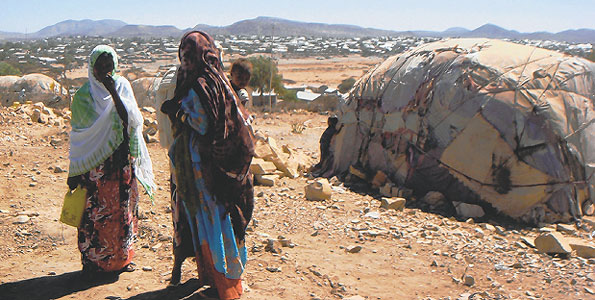
Daily Nation Despite its name, the propeller-driven Dash flies slower than its companion, the Dornier jet – taking three hours or more from Nairobi's JKIA to Hargeisa. And for most of the time, you are flying over the parched yellow-browns of northern Kenya and into Somaliland. I was in for a surprise when we reached Hargeisa. The last time I was there was back in 1999, and my memory was of a smallish and rather ramshackle town. But it was a very proud town: capital of what was once the old British colony that had disentangled itself from the chaos of Somalia to the south and east (previously, the old Italian colony, but that's not the reason for the chaos, you'll understand). Yes, Somaliland had good reason to be proud. It had regretted its hasty decision at Independence in 1960 to join the ''Greater'' Somalia, and so activated one of the five points of the star on the new Somalia flag (the ones left out were Djibouti, the Ogaden in Ethiopia and, of course, north-eastern Kenya). After the rapid disintegration of Somalia following the fall of Siad Barre in 1991, Somaliland reverted to its old name, declared its independent statehood, and set about rebuilding its institutions and infrastructures. The minefields were cleared; order was restored; the roads were opened up; money flowed in from the diaspora by means of an informal but highly effective system based on trust; and a government was established through a concentrated series of consultations using traditional approaches to conflict resolution. But, concerned about the possible effects of creating a precedent, the rest of the world didn't recognise Somaliland's separateness. It still doesn't. Despite the progress the country has made. The progress is for anyone to see in Hargeisa now – in the expanded estates, the wide streets, the flamboyant buildings, and in the mushrooming advertising hoardings. It's not a Dubai, a Nairobi or a Kampala – but it's a world away from the devastation of Mogadishu. I wasn't able to properly explore the city because, though the threat to security is not at all as strong as it is to the east and south, it is still a possibility. And so I became a kind of prisoner in the Ambassador Hotel – a very comfortable place, I must say, in which to be a kind of prisoner. But on one of my six days, I was able to escape. We drove out west in a convoy to Borama, the capital of the Awdal region, and just 10 km from the border with Ethiopia. For over two hours, we travelled through a flat and fairly arid landscape, even though the rains had not long ended. ''When I was a boy,'' my Somali companion said, ''there were lots of trees along this way – many different varieties. But see how few there are now – and look at how the thorn bushes have taken over.'' We also passed two crippled and rusting tanks – reminders of the bitter civil war that had raged across these plains. Before this trip, I had re-read one of my favourite books about the Horn – Gerald Hanley's, Warriors: Life and death among the Somalis. A British officer during the Second World War, he was also a kind of prisoner, marooned in charge of a platoon of Somalis for months on end in the bush to the north of Mogadishu. This is how Hanley describes the people he had come to respect in more ways than one: ''Of all the races of Africa, there cannot be one better to live among than the most difficult, the proudest, the bravest, the vainest, the most merciless, the friendliest: the Somalis.'' And that is why I am looking forward to going back to Somaliland and Puntland a few times during the year ahead. John Fox is Managing Director of IntermediaNCG |
|---|
WORLD MUST ACT NOW TO REVERSE WORSENING SITUATION IN AFGHANISTAN, BAN WARNS
WORLD MUST ACT NOW TO REVERSE WORSENING SITUATION IN AFGHANISTAN, BAN WARNS
New York, Jan 4 2010 4:10PM
There is currently no indication of an early improvement in the security situation in Afghanistan, which deteriorated last year – dramatically so in Kabul, the capital – and a better coordinated international effort is crucial to reversing overall negative trends, according to the latest United Nations <"http://www.un.org/Docs/journal/asp/ws.asp?m=S/2009/674">report released today.
"We are now at a critical juncture," Secretary-General Ban Ki-moon tells the Security Council in the report, which focuses on the flawed presidential election and the adverse effects of increased Taliban suicide and other attacks both for the Government's ability to deliver basic services and that of the international community to provide aid.
"The situation cannot continue as is if we are to succeed in Afghanistan. Unity of effort and greater attention to key priorities are now a sine qua non. There is a need for a change of mindset in the international community as well as in the Government of Afghanistan. Without that change, the prospects of success will diminish further."
The Afghan Government and its international partners will be meeting in London on 28 January for a high-level meeting to discuss the country's agenda in the wake of the recent elections.
Mr. Ban calls on the Government and world community to make the best possible use of the coming months to focus on agreed priorities, with a reinforced international coordination structure under a UN umbrella that will meet the principal needs of delivering services to the Afghan people and developing an economy that can gradually carry more responsibility for the people's well-being.
He cites insufficient resources as one cause of the current lack of such coordination but singles out a lack of political readiness in donor countries to adapt their thinking to meet these needs. "If the international community were to continue along a course of substituting local capacity, rather than of capacity-building, the result would be entrenchment and ultimately failure," he warns.
"If the negative trends are not corrected, there is a risk that the deteriorating overall situation will become irreversible. We cannot afford this."
Mr. Ban rejects the argument that the election, marred by fraud in the first round and by the withdrawal of President Hamid Karzai's main opponent Abdullah Abdullah in the second, was so flawed that it had condemned the state-building process to failure.
"This is incorrect. Rather, it is the weaknesses in the state-building process so far, including the ongoing culture of impunity, the still inadequate security forces, corruption and the insufficient pace of institution-building that undermined the electoral process," he writes.
"Despite the flaws, however, this is not a reason to abandon what has been achieved and what must now be built upon," he says, warning that the flaws and weaknesses must be corrected before the UN can engage in a similar supporting role for future elections. Parliamentary, district and mayoral polls are due this year, beginning in May.
Turning to the security situation, the report cites an average of 1,244 incidents per month in the third quarter of 2009, a 65 per cent increase over 2008, with armed clashes, improvised explosive devices and stand-off attacks constituting the majority.
The UN Assistance Mission in Afghanistan (<"http://unama.unmissions.org/default.aspx?/">UNAMA) recorded 784 conflict-related civilian casualties between August and October, up 12 per cent from the same period in 2008, with anti-Government elements responsible for 78 per cent of the total, of whom 54 per cent were victims of suicide and improvised explosive device attacks.
Mr. Ban notes the insurgents' intimidation and threats against civilians to discourage them from participating in the elections, targeting community leaders and clerics in particular, as well as slightly increased attacks against the aid community, a nearly daily occurrence. On average nine people were assassinated per week in the third quarter, one of whom on average was a community leader.
"The continuing high rate of direct intimidation of national staff working for the aid community, including the United Nations, continued to pose obstacles to programme delivery," he writes.
Following the 28 October attack by the Taliban on a guest house in Kabul where UN staff resided, killing five and wounding five more, some 340 UN international personnel have temporarily been relocated outside of Afghanistan.
But he reiterates that the Organization will not be deterred, with over 6,000 national and international personnel remaining on the ground. "The United Nations plays an important role in Afghanistan and has the support of the Afghan people to continuing it," he stresses.
Mr. Ban's Special Representative for Afghanistan Kai Eide will brief the Council on Wednesday on what is needed to allow UNAMA to more effectively coordinate aid and whether its mandate needs to be changed.
Mr. Eide will make clear that the extra military resources committed to Afghanistan by United States President Barack Obama and other members of the North Atlantic Treaty Organization (NATO) are much appreciated but they must be accompanied by a coherent political strategy, UNAMA spokesman Aleem Siddique told a <"http://unama.unmissions.org/Default.aspx?tabid=1761&ctl=Details&mid=1892&ItemID=7108">news briefing in Kabul today.
"For the military efforts to succeed, they must be led by a political strategy to build sustainable civilian institutions and begin a peace process under Afghan leadership and international partnership," he said.
Asked what electoral reforms were needed, he replied: "We need to see reform that prevents the sort or level of fraud and the attempted fraud that took place in the presidential polls. We need to see a removal or replacement of all those officials who were complicit in fraud, or failed to live up to the expectation of Afghanistan's voters. And we need to see cleaner and fairer elections."
UNAMA, a political Mission directed by the UN Department of Peacekeeping Operations (DPKO), was set up by the Security Council in 2002 to provide political and strategic advice for the peace process following the US-led ouster of the Taliban. It currently has some 1,500 staff, 80 per cent of them Afghan nationals.
Tighter checks for US-bound flights
| Tighter checks for US-bound flights | |||||
The US government has announced that visitors from several countries will be subject to new airport security screening procedures. Beginning on Monday, all passengers flying from or via at least 14 countries, including Nigeria and Yemen, will be patted down and have all carry-on luggage searched before boarding flights bound for the US. The move is part of the security crackdown following the attempted bombing of a Detroit-bound airliner on Christmas Day. Umar Farouk Abdulmutallab, a 23-year-old Nigerian man, was arrested after being accused of carrying an explosive device sewn into his underwear on to a Northwest Airlines flight from Amsterdam to Detroit.
The US Transportation Security Administration (TSA) said in a statement: "… every individual flying into the US from anywhere in the world travelling from or through nations that are state sponsors of terrorism or other countries of interest will be required to go through enhanced screening. "The directive also increases the use of enhanced screening technologies and mandates threat-based and random screening for passengers on US bound international flights," the US agency responsible for air security measures said. The US currently lists Cuba, Iran, Sudan and Syria as "state sponsors of terrorism" but the air travel directive also includes Afghanistan, Algeria, Iraq, Lebanon, Libya, Nigeria, Pakistan, Saudi Arabia, Somalia and Yemen, the Reuters news agency cited an Obama administration official as saying.
Chris Yates, an aviation security specialist, said that wider measures were needed to improve security on US-bound airliners. "We need to be looking at all high-risk flights, irrespective of where they come from or where they are going to, and apply the approriate measures to all passengers effectively rather than singling out a small group of nations," he told Al Jazeera from Manchester. "The system has to be a system of systems. "On the one hand we are talking about technology, but we are also talking about technique as well - profiling, additional security equipment that will give us that greater capability to detect something that we really wouldn't like to see onboard." Gordon Brown, the British prime minister, said on Sunday the authorities were acting "quickly" to introduce the new measures because a new form of explosive used by al-Qaeda "is not being identified by ordinary machines". "They [passengers] will see checks for explosive traces – that will be done on hand luggage. Transit passengers will also be checked as well as transfer passengers," he said, adding that he hoped it would not lead to longer queues at airports. The Netherlands announced on Wednesday that body scanners would be used on all flights from Amsterdam's Schipol airport to the US. The New Jersey airport's Terminal C was cleared after an unidentified man managed to bypass a security checkpoint on Sunday. Flights were grounded during the lockdown. "TSA immediately halted screening at Terminal C's security checkpoints and worked with law enforcement to pull airport surveillance tapes to identify the individual in question," Ann Davis, the agency's spokeswoman, said in a statement. Passengers were allowed to begin boarding again about six hours later, but officials said the man who had caused the alert had not been found. |


Yemen rules out US intervention
| Yemen rules out US intervention | ||||||
Yemen's foreign minister has ruled out direct US military intervention to tackle the al-Qaeda group operating in his country. "Yemen is going to deal with terrorism in its own way, out of its own interests and therefore I don't think it will counterfire," al-Qirbi said. "The negative impact on Yemen is if there is direct intervention of the US and this is not the case." Yemen is battling to control an al-Qaeda movement estimated to have hundreds of fighters in the country, as well as so-called Houthi rebel fighters in the north of the country and a secessionist movement in the south. At least two suspected al-Qaeda members were killed during a raid near Sanaa on Monday. Officials said up to three other suspects had been wounded during the operation in the Arhab district, around 30km northeast of the capital.
Hillary Clinton, the US secretary of state, said on Monday that a decision on reopening the US embassy would be taken "as conditions permit". "We see global implications from the war in Yemen and the ongoing efforts by al Qaeda in Yemen to use it as a base for terrorist attacks far beyond the region," she said after meeting the visiting prime minister of Qatar. The Yemen-based group, which claims to be affiliated with Osama bin Laden's organisation, had earlier claimed responsibility for the failed attack and called for strikes on embassies in Yemen. Gordon Brown, the British prime minister, has said he will hold a meeting in London on January 28 to discuss how to counter radicalisation in Yemen.
"I know the Americans have committed more money for our counter-terrorism units and that is one area we need support in." "The most important thing here for geopolitics globally and within the region, is that Yemen has been a fractured, desperately poor and deeply fractitious country that all the countries in the region and the superpowers have used as a battleground," she said. But Mann-Leverett also said that the Obama administration's policies towards the region were partially to blame for threats against Washington and its allies. "We have given the Saudis a green light to militarily intervene in Yemen and to characterise what is happening in Yemen as a Sunni-Shia war [with] the Saudis there to defend the Sunnis against craven Shia," she said. Aljazeera |

CrisisWatch N°77, New CrisisWatch bulletin from the International Crisis Group
CrisisWatch N°77, 4 January 2010
Six actual or potential conflict situations around the world deteriorated and none improved in December 2009, according to the new issue of the International Crisis Group's monthly bulletin CrisisWatch, released today.
The political crisis in Iran deepened over December, as anti-government protests intensified and met with further brutal crackdowns by security forces. Student protests were held in universities across the country from 7 December, followed quickly by government-staged counter-demonstrations and stern warnings by senior officials against further protests. On 27 December, violent clashes broke out in Tehran and elsewhere in rallies marking the Shiite holy day of Ashura, with 8 killed when security forces opened fire on protestors.
In Yemen, heavy fighting between government forces and rebels continued in the northern region of Saada, fuelling fears of further civilian deaths and displacement. The growth of terrorist networks in the country was underscored late month as Yemen-based al-Qaeda in the Arabian Peninsula claimed responsibility for the attempted bombing of a U.S. airliner by a Nigerian citizen on 25 December.
The situation also deteriorated in Nepal, as the Maoists called a three-day general strike from 20 December that paralysed business and infrastructure across much of the country and led to the largest street protests in Kathmandu since the Maoists quit the unity government in May. The UN condemned the excessive use of force by police against protesters. The Maoist leadership has since threatened to resume the strike indefinitely if a new unity government is not formed by 24 January, a demand Prime Minister Madhav Nepal firmly rejects.
In Nigeria, clashes between the Yan Kala Kato Islamic sect and police in Bauchi State left up to 70 dead in another deadly upsurge in violence in the north. The shooting of junta leader Dadis Camara in Guinea by one of his senior military aides on 3 December underscored the depth of divides within the military and the potential for further potentially violent unrest. In Madagascar, de facto leader Andry Rajoelina's decision to boycott power-sharing talks dealt a further blow to prospects for a negotiated solution to the ongoing political standoff that has gripped the country since Rajoelina's unconstitutional takeover in March 2009.
December 2009 TRENDS
Deteriorated Situations
Guinea, Iran, Madagascar, Nepal, Nigeria, Yemen
Improved Situations
Unchanged Situations
Afghanistan, Algeria, Armenia, Armenia/Turkey, Azerbaijan, Bangladesh, Basque Country (Spain), Belarus, Bolivia, Bosnia, Burundi, Cameroon, Central African Republic, Chad, Chechnya (Russia), Colombia, Côte d'Ivoire, Cyprus, Democratic Republic of Congo, Ecuador, Egypt, Eritrea, Ethiopia, Georgia, Guinea-Bissau, Haiti, Honduras, India (non-Kashmir), Indonesia, Iraq, Israel-OPT, Kashmir, Kazakhstan, Kenya, Kosovo, Kyrgyzstan, Lebanon, Liberia, Macedonia, Mali, Mauritania, Moldova, Myanmar/Burma, Nagorno-Karabakh (Azerbaijan), Niger, North Caucasus (non-Chechnya), Northern Ireland, North Korea, Pakistan, Philippines, Rwanda, Saudi Arabia, Serbia, Somalia, Sri Lanka, Sudan, Syria, Taiwan Strait, Tajikistan, Thailand, Timor-Leste, Turkey, Turkmenistan, Ug anda, Ukraine, Uzbekistan, Venezuela, Western Sahara, Zimbabwe
January 2010 OUTLOOK
Conflict Risk Alert
Conflict Resolution Opportunity
*NOTE: CrisisWatch indicators - up and down arrows, conflict risk alerts, and conflict resolution opportunities - are intended to reflect changes within countries or situations from month to month, not comparisons between countries. For example, no "conflict risk alert" is given for a country where violence has been occurring and is expected to continue in the coming month: such an indicator is given only where new or significantly escalated violence is feared.
Somalia Is Greatest Victim Of President Bush’s War On Terror
|
Blasts kill 4 US, one UK soldiers in Afghanistan
 |
The dead soldiers, who were serving under NATO's International Security Assistance Force, were killed on Sunday, NATO said in a statement Monday.
The US soldiers died following an improvised explosive device strike, the statement said without giving more details.
Meanwhile, a British soldier was killed in another roadside bomb blast in southern Afghanistan, according to British forces.
The British soldier, from 1st Battalion The Royal Anglian Regiment, died after the blast hit a foot patrol in Helmand province.
Regarding US casualties in Afghanistan, the number of American service personnel killed in the war-torn country in 2009 is more than twice that of 2008.
Since the US-led invasion of Afghanistan in 2001, countless number of American and foreign troops along with Afghan civilians have been killed in the country.
AGB/SC/DT
ditorial: Spoilt child, indeed
| ditorial: Spoilt child, indeed Arab News |
The international community's pandering of Israel has indeed helped it in waging war but not in making peace. Foreign Minister Prince Saud Al-Faisal's statement that Israel is a "spoilt child that gets away with anything without being questioned, held accountable or punished" neatly sums up the situation. Calling on the international community to get tougher with Israel, especially on settlements, the prince did not name names, but there is no prize for guessing the No. 1 pamperer. President Barack Obama knows that whatever Middle East plan he has will succeed or flop depending on Israel's willingness to accede rights stolen from the Palestinians. However, it is clear by now that Israel will not be making any concessions, either to the Palestinians or to the US. Benjamin Netanyahu knows Obama and a pro-Israel Congress will not be willing to push US' key regional ally. Israel has been allowed to say "no" to the United States without suffering any consequences. The Palestinians thus feel betrayed by the Obama administration that has backed down from its own insistence that Israel halt construction in occupied territory. Who can criticize Palestinians when they say it is pointless to go through the motions of yet another series of negotiations with an Israeli government more hawkish than its predecessors and with a US administration as accommodating of Israeli wishes as any in recent US history? When Israel's electorate voted last year, it installed a right-wing governing coalition beholden to parties opposed to a Palestinian state. This makes it impossible for Netanyahu to accept the settlement freeze even as a tactic. It is highly unlikely that he could conclude a deal acceptable to the Palestinians. When other countries violate international law, if war crimes are committed, said Prince Saud, they get punished, except for Israel. Yugoslav President Slobodan Milosevic, Liberia's Charles Taylor, and Radovan Karadzic, the ultranationalist leader of the Bosnian Serbs, are all examples of what happens when leaders believe they are above the law and are unaccountable for their actions. Was not Israel's 22-day assault on the Gaza Strip last year a war crime? Was not an attack that killed 1,400 Palestinians — more than 400 minors among them — a crime against humanity? Yet Israel has been allowed to get away with murder. Prince Saud's comments on the Palestinian problem came four days after King Abdullah held talks with President Mahmoud Abbas on the same issue, and ahead of yet another expected trip to the region by US Middle East peace envoy George Mitchell. The US seems to be operating on the assumption that the Palestinians are ready for any kind of peace — with a leadership politically dependent on the US and one that is ready to suppress opposition elements seeking to confront Israel. As Israel's encroachment in the West Bank and East Jerusalem has continued apace, the Palestine Authority remains helpless. In the eyes of the Palestinians, the Obama administration's retreat on the settlement issue signals that without such US pressure on Israel, there's nothing to be gained from talking to the Netanyahu government because the three decades spent relying on US-led diplomacy to deliver Palestinian national goals has brought precious little. |
Monday, January 4, 2010
SOMALIA: Thousands displaced by clashes in Galgadud
NAIROBI, 4 January 2010 (IRIN) - Thousands of families have fled Somalia's central town of Dusamareb, the regional capital of Galgadud, after a weekend of fighting between Islamist groups killed dozens and left many others injured, locals told IRIN.
On 2 January, Al-Shabab attacked Dusamareb, 500km north of the capital Mogadishu, and captured it from Ahlu Sunna Waljama'a - a traditional Sufi group - for a short while before being forced out again.
"Our estimate is that between 6,000 and 7,000 families [32,000 to 42,000 people] have fled and are now displaced," Sheikh Abdirahman Gedoqorow, a religious leader, told IRIN on 4 January.
Most of the displaced are scattered across rural villages and towns in the region, he said.
Gedoqorow said those displaced were facing difficult conditions due to insufficient assistance in the areas to which they had fled. "There is no one out there helping them and the area has been ravaged by drought."
He said the displaced "desperately" needed shelter material, food and water, the most urgent requirement.
Rising death toll
A local leader estimated that 50 people had so far died in the fighting and at least 80 had been injured. However, a journalist, who requested anonymity, said the death toll was likely to be higher.
"The majority of those who died were from the invading [Al-Shabab] group," the journalist said.
The two groups have been battling for control of the country's central regions since Ahlu Sunna Waljama'a routed Al-Shabab from the area in December 2008.
The journalist added that Al-Shabab had since been reported to have left the area. "They are nowhere near Dusamareb. They took a beating on Saturday [2 January]."
Dusamareb, a town of about 40,000, has in the past three years hosted thousands of displaced people from Mogadishu. "Whether residents or IDPs, almost 80 percent are now displaced," the journalist added.
Security assured
While acknowledging that aid agencies would be reluctant to come to the aid of the displaced - given the insecurity - Gedoqorow said agencies seeking to help should contact community leaders.
"Despite rumours, the situation now is under control and we have complete security in the town," he said. "No one should be afraid."
Sporadic fighting has been going on across the country since Ethiopian troops withdrew in December 2008, pitting African Union-backed government forces against Islamist insurgents.
Aid workers estimate that at least 3.6 million Somalis need assistance countrywide while the UN Refugee Agency (UNHCR) estimates that up to 1.5 million Somalis are displaced.
Abdirazaq Moalim, the head of the education department in Dusamareb, told IRIN all schools in the town were closed as most students had stayed away.
"The students have not returned yet and we are not sure when they will," Moalim, who also fled with his family, said.
He said there was a general fear of Al-Shabab returning.
Moalim said many of the displaced had gone to areas with very little water. "I am carrying five [20-litre] jerry cans of water to the displaced in Eil Barkad [10km north of Dusamareb]," he said.
ah/mw[END]
TOP UN ENVOY CALLS FOR 'DEMILITARIZED' INTERNATIONAL APPROACH IN AFGHANISTAN
New York, Jan 3 2010 7:10PM
The international community must demilitarize its overall approach in Afghanistan to ensure sustainable gains in the political and humanitarian realms, the outgoing top United Nations envoy to the South Asian nations said today.
"We have to get into a mode where our strategy is politically driven and not militarily driven, where the political and civilian components become an appendix to a military strategy," Kai Eide, the Secretary-General's Special Representative, <"http://unama.unmissions.org/Default.aspx?tabid=1741&ctl=Details&mid=1882&ItemID=7100">said in the capital, Kabul.
He will address the Security Council this week for the last time as the world body's top official in Afghanistan on what he expects in the coming months for the country.
One of the top objectives of the influx of troops this year is to boost the Afghan military's capacity, he told reporters today.
"I am deeply skeptical [of] a situation where we have an increase of military forces and that increase of military forces engages in political, civilian and humanitarian issues," Mr. Eide said, stressing that an increased number of forces means that they try to demonstrate "quick results."
But, he emphasized, "quick impact very often becomes quick collapse."
Afghanistan's Government must initiate a peace process based on compromise as swiftly as possible, the envoy said, adding that participation by insurgents will increase the prospect of gradual troop withdrawals.
He also said that while he respects the Independent Election Commission's decision to follow Afghanistan's constitution by holding parliamentary elections as early as May, he voiced concern over the limited time available to hold the polls, especially since last year's presidential and provincial council elections were marked by fraud and insecurity.
"For me... it is important that a real reform process takes pl
ace before the next elections," the Special Representative said.
This weekend, Afghan politicians rejected most of the names put forward by President Hamid Karzai for his new cabinet, and Mr. Eide called this a "political setback, in the sense that it prolongs the situation without a functioning government."
Later this month, an international conference on Afghanistan -- the result of a joint European proposal by the United Kingdom, France and Germany -- will be held in London, which Secretary-General Ban Ki-moon has <"http://www.un.org/apps/sg/sgstats.asp?nid=4258">characterized as a "a very timely" opportunity to discuss the country's agenda in the wake of the presidential elections which re-elected Mr. Karzai after his opponent, Abdullah Abdullah, withdrew from the run-off round.
Another high-level conference is also scheduled to be held in Kabul in several months.
Sunday, January 3, 2010
Warsaxaafadeedkii 1aad ee Xisbiga sanadka cusub
01 December 2009, Gudoomiyaha Xisbiga KULMIYE Md. Axmed Maxamed Siilaanyo wuxuu la kulmay Mr. John Marshal oo ah Ku-Xigeenka Saafiirka ingiriiska u fadhiya Addis- Ababa iyo Matt woods oo ah second Secretary-ga iyagoo kawada hadlay degganaanshaha, nabad kuwada noolaanshaha dawaladaha Geeska Africa., geeddi socodka dimoqraadiyadda.
Dhinaca kale waxay kawada hadleen doorashooyinka somaliland iyo siday uga go'antahay Dawladda Ingiriiska qabsoomidda doorasho ee la filaayo inay dhacdo horraanta sannadka 2010. Kulankaasi wuxuu ku dhacay jawi fiican iyo is-faham.
Sidoo kale, waxaa 01 January 2010 Guddoomiyaha xisbiga KULMIYE Axmed Maxamed Siilaanyo uu kulan qado sharafeeda la yeeshay Wasiiru Dawlaha Wasaaradda Arrimaha dibadda ee Itoobiya Mudane Tekede Allamu iyo Masuuliyiin kale oo ka tirsan Wasaaraddaasi. Kulankaasi oo ay kaga wada hadleen xaaladaha ka taagan mandaqadda Geeska Afrika iyo siday Bulshada caalamku diyaar ugu tahay degenaanshaha, xasilloonida iyo nabad kuwada noolaanshaha dawladaha mandaqadda.
Sidoo kale, waxay ka wada hadleen xidhiidhka iyo cilaaqaadka wanaagsan ee labada dal Somaliland iyo Itoobiya, iyo sidii loo sii adkayn lahaa geedi socodka nabada iyo horumarka Somliland iyo qabsoomidda doorashooyinka soo socda. Taasi oo uu Guddoomiyaha Kulmiye Axmed Maxamed uu uga mahadanaqay soo dhawaynta kulankaa sharafta leh ee dawladda itoobiya ku qaabishay.
Waxaana la filayaa inuu sii wato kulamadiisa shaqo maalmaha soo socda, isagoo uga sii gudbi doona safarkiisii shaqo ee uu ku tagayo dalka Maraykanka maalinta Khamiista ee bisha January tahay 07 January 2010.
Allaa Mahad leh
Md. Keyse Xasan Cige
Xoghayaha Guud ee Xisbiga KULMIYE
Xarunta Dhexe ee Xisbiga KULMIYE
Somaliland, Hargeysa
__._,_.___
Reply to sender | Reply to group
Messages in this topic (1)
Recent Activity:
New Members 10
Visit Your Group Start a New Topic
OGAYSIIS::- Fadlan anshaxa golaha ilaaliya // Ha soo dirin email aflagaado ah // isku day email kooban oo wax laga korodhsado // due to limited space::- emailka aad u jawaabayso dib ha u soo dirin // emailkaaga laba jeer ha soo dirin
MARKETPLACE
Going Green: Your Yahoo! Groups resource for green living
Switch to: Text-Only, Daily Digest • Unsubscribe • Terms of Use
.
__,_._,___
Danish cartoonist attacked
Friday, January 1, 2010
A History of the New Year
The celebration of the new year on January 1st is a relatively new phenomenon. The earliest recording of a new year celebration is believed to have been in Mesopotamia, c. 2000 B.C. and was celebrated around the time of the vernal equinox, in mid-March. A variety of other dates tied to the seasons were also used by various ancient cultures. The Egyptians, Phoenicians, and Persians began their new year with the fall equinox, and the Greeks celebrated it on the winter solstice.
Early Roman Calendar: March 1st Rings in the New Year
The early Roman calendar designated March 1 as the new year. The calendar had just ten months, beginning with March. That the new year once began with the month of March is still reflected in some of the names of the months. September through December, our ninth through twelfth months, were originally positioned as the seventh through tenth months (septem is Latin for "seven," octo is "eight," novem is "nine," and decem is "ten."
January Joins the Calendar
The first time the new year was celebrated on January 1st was in Rome in 153 B.C. (In fact, the month of January did not even exist until around 700 B.C., when the second king of Rome, Numa Pontilius, added the months of January and February.) The new year was moved from March to January because that was the beginning of the civil year, the month that the two newly elected Roman consuls—the highest officials in the Roman republic—began their one-year tenure. But this new year date was not always strictly and widely observed, and the new year was still sometimes celebrated on March 1.
Julian Calendar: January 1st Officially Instituted as the New Year
In 46 B.C. Julius Caesar introduced a new, solar-based calendar that was a vast improvement on the ancient Roman calendar, which was a lunar system that had become wildly inaccurate over the years. The Julian calendar decreed that the new year would occur with January 1, and within the Roman world, January 1 became the consistently observed start of the new year.
Middle Ages: January 1st Abolished
In medieval Europe, however, the celebrations accompanying the new year were considered pagan and unchristian like, and in 567 the Council of Tours abolished January 1 as the beginning of the year. At various times and in various places throughout medieval Christian Europe, the new year was celebrated on Dec. 25, the birth of Jesus; March 1; March 25, the Feast of the Annunciation; and Easter.
Gregorian Calendar: January 1st Restored
In 1582, the Gregorian calendar reform restored January 1 as new year's day. Although most Catholic countries adopted the Gregorian calendar almost immediately, it was only gradually adopted among Protestant countries. The British, for example, did not adopt the reformed calendar until 1752. Until then, the British Empire —and their American colonies— still celebrated the new year in March.
http://www.infoplease.com/spot/newyearhistory.html