Friday, January 18, 2013

Foreigners still caught in Sahara hostage crisis

Foreigners still caught in Sahara hostage crisis

Related Topics

File photo of the gas field in Amenas, Algeria in this handout photo provided by Scanpix April 19, 2005. REUTERS/Kjetil Alsvik/Statoil via Scanpix

ALGIERS | Fri Jan 18, 2013 12:00pm EST

(Reuters) - More than 20 foreigners were still being held hostage or missing inside a gas plant on Friday after Algerian forces stormed the desert complex to free hundreds of captives taken by Islamist militants, who threatened to attack other energy installations.

Thirty hostages, including at least seven Westerners, were killed during Thursday's assault, along with at least 18 of their captors, said an Algerian security source.

The attack, which plunged capitals around the world into crisis mode, is a serious escalation of unrest in northwestern Africa, where French forces have been in Mali since last week fighting an Islamist takeover of Timbuktu and other towns.

"We are still dealing with a fluid and dangerous situation where a part of the terrorist threat has been eliminated in one part of the site, but there still remains a threat in another part," British Prime Minister David Cameron told his parliament.

A local Algerian source said 100 of 132 foreign hostages had been freed from the facility. The fate of the other 32 was unclear as the situation was changing rapidly.

Earlier he said 60 were still missing with some believed still held hostage, but it was unclear how many, and how many might be in hiding elsewhere in the sprawling compound.

Two Japanese, two Britons and a French national were among the seven foreigners confirmed dead in the army's storming, the Algerian security source told Reuters. One British citizen was killed when the gunmen seized the hostages on Wednesday.

Those still unaccounted for on Friday included 10 from Japan and eight Norwegians, according to their employers, and a number of Britons which Cameron put at "significantly" less than 30.

France said it had no information on two Frenchmen who may have been at the site and Washington has said a number of Americans were among the hostages, without giving details. The local source said a U.S. aircraft landed nearby on Friday.

Some countries have been reluctant to give details of the numbers of their missing nationals to avoid disclosing information that may be useful to their captors.

As Western leaders clamored for news, several expressed anger they had not been consulted by the Algerian government about its decision to storm the facility.

The sprawling facility housed hundreds of workers. Algeria's state news agency said the army had rescued 650 hostages in total, 573 of whom were Algerians.

"(The army) is still trying to achieve a 'peaceful outcome' before neutralizing the terrorist group that is holed up in the (facility) and freeing a group of hostages that is still being held," it said, quoting a security source.

MULTINATIONAL INSURGENCY

Algerian commanders said they moved in on Thursday about 30 hours after the siege began because the gunmen had demanded to be allowed to take their captives abroad.

An Irish engineer who survived said he saw four jeeps full of hostages blown up by Algerian troops.

A French hostage employed by a French catering company said Algerian military forces had found some British hostages hiding and were combing the sprawling In Amenas site for others when he was escorted away by the military.

"I hid in my room for nearly 40 hours, under the bed. I put boards up pretty much all round," Alexandre Berceaux told Europe 1 raid. "I didn't know how long I was going to stay there ... I was afraid. I could see myself already ending up in a pine box."

"When Algerian solders ... came for me, I didn't even know it was over. They were with some of my colleagues, otherwise I'd never have opened the door."

Western governments are trying to determine the degree to which the hostage taking was part of an international conspiracy and was linked, as the captors claimed, to the week-old French military intervention in neighboring Mali.

The Algerian security source said only two of 11 militants whose bodies were found on Thursday were Algerian, including the squad's leader. The others comprised three Egyptians, two Tunisians, two Libyans, a Malian and a Frenchman, he said.

Algeria state news agency APS said the group had planned to take the hostages to Mali.

The plant was heavily fortified, with security, controlled access and an army camp with hundreds of armed personnel between the accommodation and processing plant, Andy Coward Honeywell, who worked there in 2009, told the BBC.

U.S. Defense Secretary Leon Panetta said those responsible would be hunted down: "Terrorists should be on notice that they will find no sanctuary, no refuge, not in Algeria, not in North Africa, not anywhere," he said in London. "Those who would wantonly attack our country and our people will have no place to hide."

MALI WOES

The crisis posed a serious dilemma for former colonial power Paris and its allies as French troops attacked the hostage-takers' al Qaeda allies in Mali, another former colony.

The desert fighters have proved to be better trained and equipped than France had anticipated, diplomats told Reuters at the United Nations, which said 400,000 people could flee Mali to neighboring countries in the coming months.

In Algeria, the kidnappers warned locals to stay away from foreign companies' oil and gas installations, threatening more attacks, Mauritania's news agency ANI said, citing a spokesman for the group.

Algerian workers form the backbone of an oil and gas industry that has attracted international firms in recent years partly because of military-style security. The kidnapping, storming and further threat cast a deep shadow over its future.

Hundreds of workers from international oil companies were evacuated from Algeria on Thursday and many more will follow, BP, which jointly ran the gas plant with Norway's Statoil and the Algerian state oil firm, said on Friday.

The overall commander of the kidnappers, Algerian officials said, was Mokhtar Belmokhtar, a veteran of Afghanistan in the 1980s and Algeria's bloody civil war of the 1990s and one of a host of Saharan Islamists, flush with arms and fighters from the 2011 civil war in Libya. He appears not to have been present.

Algerian security specialist Anis Rahmani, author of several books on terrorism and editor of Ennahar daily, told Reuters about 70 militants were involved from two groups, Belmokhtar's "Those who sign in blood", who travelled from Libya, and the lesser known "Movement of the Islamic Youth in the South".

"They were carrying heavy weapons including rifles used by the Libyan army during (Muammar) Gadaffi's rule," he said. "They also had rocket-propelled grenades and machineguns."

Algeria's government is implacably at odds with Islamist guerrillas who remain at large in the south, years after the civil war through the 1990s in which some 200,000 people died.

Britain's Cameron, who warned people to prepare for bad news and who cancelled a major policy speech on Friday to deal with the situation, said he would have liked Algeria to have consulted before the raid. Japan made similar complaints.

U.S. officials had no clear information on the fate of Americans, though a U.S. military drone had flown over the area. Washington, like its European allies, has endorsed France's move to protect the Malian capital by mounting air strikes last week and now sending 1,400 ground troops to attack Islamist rebels.

The apparent ease with which the fighters swooped in from the dunes to take control of an important energy facility, which produces some 10 percent of the natural gas on which Algeria depends for its export income, has raised questions over the value of outwardly tough security measures.

(Additional reporting by Ali Abdelatti in Cairo, Eamonn Mallie in Belfast, Gwladys Fouche in Oslo, Mohammed Abbas in London and Padraic Halpin and Conor Humprhies in Dublin; Writing by Philippa Fletcher; Editing by Peter Graff)

TASTING THE SWEETEST BLESSINGS IN THIS WORLD

TASTING THE SWEETEST BLESSINGS IN THIS WORLD

    The coming of disasters may be unpleasant outwardly, but it is expected that they will be blessings. The world's most valuable stock is (collected from) sorrows and afflictions. The most delicious food on the world's meal table is (made up of) problems and calamities. These sweet blessings are covered with bitter medicine. Therefore, calamities and disasters are showered on the beloved ones. Those who are fortunate and wise see the sweets placed in them. They chew the bitter covers on them as if they were sweet. They take flavour from the bitter. Why shouldn't they, since everything coming from the Beloved will be sweet. Those who are sick do not feel their taste. 

    The heart's sickness means its having fallen in love with somebody other than He. The fortunate ones take so much flavour from the troubles coming from the Beloved One that they do not taste the same flavour in His favours. Though both are coming from the Beloved One, the lover's nafs [1]does not get a share from the hardships. But His favours are wished by the nafs, too. Translation of an Arabic line: 

    May it do good to those who get the blessing! 

    O our Allah! Do not deprive us of the rewards of these hardships! After these, do not let us fall into faction!

Thursday, January 17, 2013

Algeria Siege: 'Lethal Strike' On Gas Plant


Algeria Siege: 'Lethal Strike' On Gas Plant

Some foreign hostages are reported to be free, but news agencies say others have been killed amid an ongoing operation.
5:30pm UK, Thursday 17 January 2013


The family of Irishman Stephen McFaul have said they are "delighted" he is no longer being held hostage at an Algerian gas complex, where other foreign workers are still reportedly detained.

Video: Family's Relief At Hostage ReleaseEnlarge

Tweet


Email


A number of foreign hostages at a besieged Algerian gas plant have reportedly been freed in the wake of a military strike which news agencies say has killed several people.

Mauritania's ANI news agency reported the deaths citing one of the kidnappers who had earlier taken 41 people, including Britons, captive at the compound near the border with Libya.

And French president Francois Hollande said the hostage crisis was unfolding in "terrible conditions".

The official Algerian APS news agency said a number of foreign hostages were free. Among them was 36-year-old Irishman Stephen McFaul from west Belfast.

His father, Christopher McFaul, told Sky News he was "delighted" his son was no longer being held captive but added he felt "sorry for the other hostages that are still there". He also described the last 48 hours as "hell".

Stephen McFaul's son, Dylan, said: "I can't even explain the excitement. I can't wait until he gets home again."

He added he would tell him "he's never going back there and I'm not letting him".

APS said as many as 600 Algerian workers at the site managed to flee the plant, and an American military official said at least one US unarmed drone was flying over the complex.

A large explosion has been heard away from the accommodation block at the remote desert plant, Sky sources said.

News agency Reuters spoke to a local resident who said many people were killed in the military operation, which the Algerian government confirmed it was carrying out.The gas complex is at In Amenas, in eastern Algeria
The Algerian government said it had to act "immediately" to intervene in the hostage crisis, according to Downing Street.

David Cameron's spokesman said Britain was not given prior notice of the operation, adding it was ongoing and the situation was "very grave and serious".

Mr Cameron was informed the operation was under way when he telephoned the Algerian prime minister at 11am today, the spokesman added.

And the British PM made clear he would have preferred to be informed in advance of the military action, the spokesman went on.

There have been conflicting reports as to the number of casualties, with Reuters citing a local source as saying six foreign hostages and eight rebels were killed.

The source said some hostages were still being held.

ANI said the attackers' spokesman had claimed that Algerian forces opened fire as the militants tried to leave the energy complex with hostages.

The facility is run jointly by BP, the Norwegian energy firm Statoil and the Algerian state oil company.

On Wednesday a Briton and an Algerian were killed when around 20 gunmen from an al Qaeda-backed group stormed the In Amenas facility.

Among the UK nationals taken hostage by the group were Scottish nationals, Scottish National Party leader Alex Salmond confirmed earlier.

Al Qaeda-linked militant group Katibat Moulathamine - The Masked Ones - claimed responsibility for the attack.

The group said it was retaliating for French military intervention against al Qaeda-backed rebels in neighbouring Mali, where France now has 1,400 troops on the ground.

Foreign Secretary William Hague earlier said he was sceptical the attack was a retaliation over the offensive against Islamist fighters in Mali because it would take longer to plan.

BP said it was evacuating a group of workers from Algeria after Islamist gunmen took dozens of foreigners hostage at the In Amenas plant.

Monday, January 14, 2013

India Police Arrest 6 in Another Gang Rape Case


India Police Arrest 6 in Another Gang Rape Case


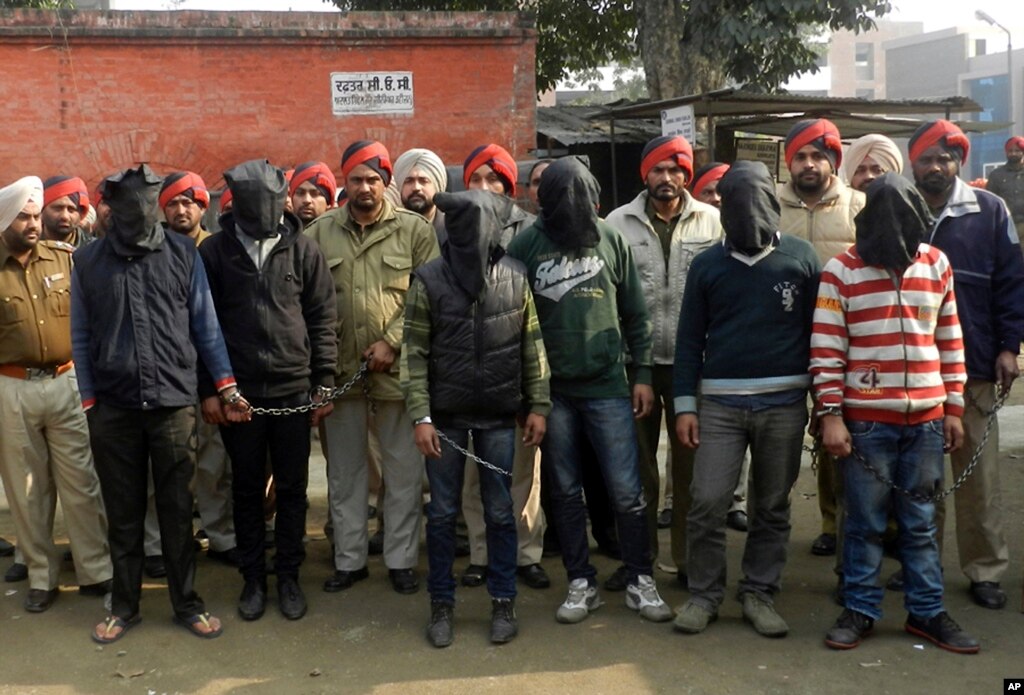
Indian policemen stand with six men, face covered in black sheet, suspected in a gang rape of a bus passenger in Punjab state, India, January 13, 2013.


RELATED ARTICLES

India Rape Victim's Father Wants to Publicize Daughter's Name
Indian Gang Rape Suspects Appear in Court
India Rape Lawyer Alleges Evidence Tampering, Coercion


VOA News

January 13, 2013
Police in India say they have arrested six men accused of raping a woman after abducting her on a passenger bus, weeks after a similar gang rape of a female student shocked the nation.

Authorities say the 29-year-old victim was the only passenger on the bus as she was travelling to her village in northern Punjab state late Friday.

According to the victim, the driver drove her to a desolate location, where he, the conductor and five friends took turns raping her before dropping her off at her village early Saturday.

Police arrested six suspects in the case after the woman filed a complaint Saturday. A police spokesman says the men have confessed to the crime.

Meanwhile, five of the six suspects accused of brutally raping a 23-year-old woman after luring her and her male friend on a bus in New Delhi last month are set to go to trial in a fast-track court. The sixth suspect is under 18 and will be tried separately in a juvenile court.

The expedited proceedings are in response to public outrage over the brutality of the attack. The defendants are accused of beating the couple with an iron rod and using the rod during the sexual assault of the woman.

The unidentified victim died of her severe internal injuries on December 29 in a Singapore hospital, where she had been taken for treatment.

The lawyer for three of the suspects says his clients will plead not guilty and that police used force to gain confessions from them.

M.L. Sharma spoke to reporters Thursday on the way to a closed-door hearing in New Delhi. He said police manipulated the evidence to make his clients appear guilty.

Two of the accused, in an effort to receive lighter sentences, have told the court that they want to become witnesses for the prosecution.

Indian authorities have charged the men with murder, rape, kidnapping and other charges. Officials say they will push for the death penalty, if the men are convicted.

The woman's rape and death sparked outrage across the country. Protesters have called for tougher rape laws, major police reforms and a transformation in the way India treats women.


Some information for this report was provided by AP and AFP.

Sunday, January 13, 2013

Egyptian court orders Hosni Mubarak retrial


Egyptian court orders Hosni Mubarak retrial


Decision to retry ousted president, interior minister and aides may help repair President Mohamed Morsi's standing


Abdel-Rahman Hussein in Cairo
guardian.co.uk, Sunday 13 January 2013 

Hosni Mubarak: Egyptian doctors say the former president's heart condition means he is too ill to be held in jail while awaiting trial. Photograph: Dennis Brack/EPA


Former Egyptian president Hosni Mubarak will be retried for the killing of protesters during the uprising that ousted him after a Cairo court accepted his appeal.

Mubarak will be retried alongside his then interior minister, Habib el-Adly, who along with the former president was sentenced to a life term last July for failing to prevent the killing of protesters by security forces. Six of Adly's aides who were acquitted in the initial trial will also be retried.

Mubarak will remain under arrest on charges recently brought against him concerning the millions of Egyptian pounds that he and others received as gifts from the country's biggest state-owned newspaper, al-Ahram. Also acquitted in the initial trial were Mubarak's sons, Alaa and king-in-waiting Gamal. They remain in jail on other charges relating to financial crimes and abuse of power.

News of the retrial was greeted by both Mubarak's opponents and his few remaining supporters. For his supporters – who celebrated the court decision – the retrial offers the hope that the former dictator will be able to spend his remaining years outside the military hospital in which he resides. For opponents, it represents a chance to build a stronger case against him and his police commanders for the violence perpetrated against protesters.

It may also present an opportunity for Mubarak's successor, the Muslim Brotherhood's Mohamed Morsi. The beleaguered Morsi needs strong convictions against the Mubarak coterie, especially as most of the police chiefs on the ground during the January 2011 revolt have been acquitted.

In the contentious decree he issued last November, Morsi ordered the retrial of Mubarak and other former regime stalwarts, only to be told that by law new evidence was needed to trigger a retrial.

An independent fact-finding commission has since found that – contrary to defence claims during the trial – Mubarak knew of the killings via a live feed he watched at the presidential palace.

Morsi also contentiously removed Egypt's public prosecutor, replacing him with his own appointment. Since Egyptian law prevented the dismissal of the public prosecutor, Morsi changed the law that governed the appointment, a move that was seen as an attack on the independence of the judiciary.

Egypt's prosecution service had been severely criticised for not building strong enough cases against members of the Mubarak regime, and many blamed the public prosecutor, a Mubarak appointment.

However, Morsi's move did not have the requisite populist effect as the decree also included law articles that granted him extraordinary powers and judicial immunity, privileges he extended to a constituent assembly that drafted Egypt's constitution.

The constitution passed in a referendum amid much protest and polarisation, damaging Morsi's standing. His supporters hope a stronger conviction in the Mubarak trial would repair some of the damage.

Saturday, January 12, 2013

Torture evidence shows danger of secret courts

Torture evidence shows danger of secret courts

The Guardian today covers the leak of two versions of a "highly sensitive military witness statement" which illustrates "the dangers of government plans to expand secret courts".

The document concerns the details of a case involving an Afghan detainee who was arrested by British forces and later handed over to Afghan forces who, he claims, beat him "on his feet and legs with metal rods until he was unable to stand."

The Guardian states that at the time the case was heard in 2010, it "was one of the few examples of a secret hearing, known as a closed material procedure (CMP), being used in the civil courts". The two versions of the text, which you can see here and here, illustrate how significant information on the detainee's case was initially withheld on the authority of the High Court. Redacting information was permitted until the practice was subsequently judged illegal by the Supreme Court. According to the Guardian, the Government's proposal to extend secret trials as detailed in the Justice and Security Bill, was in direct response to this ruling.

The Guardian states that "the partially suppressed version cuts out crucial details about torture allegedly being inflicted [on the detainee]". It continues, "lawyers who fought the case claim the two versions demonstrate how politically embarrassing evidence can be concealed under the veil of protecting national security."

The Guardian adds that the way that the evidence was treated by the High Court "challenges repeated assurances by the Cabinet Office minister without portfolio, Ken Clarke, that the justice and security bill will not result in anything that is currently disclosed being withheld in future."

Shortly after the case concerning the Afghan detainee, another Afghan detainee, Serdar Mohammed, also arrested by British soldiers and transferred to Afghan security services, claimed he was tortured and it was the legal proceedings which followed his transfer that led to the release of the full MoD witness statement.

The Justice and Security Bill was defeated in the House of Lords late last year after the Lords imposed safeguards, including removing the secretary of state's right to apply for a secret hearing and giving judges more discretion on deciding whether hearings should be held in secret. The Bill will soon move into the committee stage in the House of Commons. 

Under the proposals, victims and their lawyers would be prevented from seeing the evidence against them and would be represented instead by 'special advocates'. Critics say that this would unfairly advantage the government over the claimant. The government claims that judges and not ministers would decide on the application of CPMs, however this has been challenged by the shadow justice secretary, Sadiq Khan, who has argued that the Government's claim of the process being "judge-led" is "positively misleading".

Liberal Democrat parliamentary candidate and former lawyer, Jo Shaw, who has led her party's opposition to secret courts said that "the two statements shockingly demonstrate exactly what many … have been worried about: coverups made possible by secret courts in the illiberal, unnecessary and unfair justice and security bill."

She added that, "What was being kept from the public eye in this case was not information which would threaten the life of security services personnel, or the security of the UK. It was information which was embarrassing to the security services and to the government, because it showed the knowledge of UK officers about torture in Afghanistan gaols run by our allies.

"Covering up difficult or embarrassing facts about complicity in torture or rendition helps no one. To ensure there is no UK involvement with such wrongdoing in future we need open justice, not secret courts. It is equally appalling that Ken Clarke has refused to rule out using secret courts in claims brought by injured service personnel, or in claims for habeas corpus."


From the moment that the government's proposal to extend the mandate for secret trials surfaced, there has been strong speculation that the proposals have less  to do with security and more to do with preventing and mitigating damage done to the Government's compliance with and reputation for adhering to treaty obligations on the treatment of prisoners and on torture.

The revelations in today's Guardian will serve to further entrench suspicions that the Government's notion of 'national security' is clouded by its own self-interest and fails to take into account the public interest in open justice. As the Joint Committee on Human Rights said of the bill, it is a "radical departure from fundamental common law traditions". Whether the bill survives passage through both Houses of Parliament remains to be seen.

Wednesday, January 9, 2013

Daily Hadith and Ayat, 08-01-2013

بِسۡمِ ٱللهِ ٱلرَّحۡمَـٰنِ ٱلرَّحِيمِ 

Peace and blessings be upon the Beloved Prophet Muhammad,
As-salamu-alaikum your daily hadith from ahadith.co.uk

Daily Hadith, 08-01-2013

Narrated: Nafi
Ibn 'Umar said, "Allah's Apostle said, 'If the supper is served for anyone of you and the Iqama is pronounced, start with the supper and don't be in haste (and carry on eating) till you finish it." If food was served for Ibn 'Umar and Iqama was pronounced, he never came to the prayer till he finished it (i.e. food) in spite of the fact that he heard the recitation (of the Qur'an) by the Imam (in the prayer). Narrated Ibn 'Umar: The Prophet said, "If anyone of you is having his meals, he should not hurry up till he is; satisfied even if the prayer has been started."
hadith Source »
Source For Mobile Devices »

Ayat of the Quran

Verse No: 70

مَتَاعٌ فِي الدُّنْيَا ثُمَّ إِلَيْنَا مَرْجِعُهُمْ ثُمَّ نُذِيقُهُمُ الْعَذَابَ الشَّدِيدَ بِمَا كَانُوا يَكْفُرُونَ

This world's portion (will be theirs), then unto Us is their return. Then We make them taste a dreadful doom because they used to disbelieve.
Yunus (Jonah) »
English Quran »

Daily Remembrance

الْخَافِضُ
Al-Khaafid: The Reducer
Meaning: The Abaser, The One who lowers whoever He willed by His Destruction and raises whoever He willed by His Endowment.
Found In Quraan Ayah(s): (95:5)
View All Names Off Allah »

Selected Hadith Commentary

Narrated: Abu Huraira
Hadith No: 15, that the Messenger of Allah, sallallahu 'alayhi wasallam, said: "Let whosoever believes in Allah and in the Last Day either speak good or be silent. Let whosoever believes in Allah and in the Last Day honour his neighbour. Let whosoever believes in Allah and in the Last Day honour his guest." [Al-Bukhari & Muslim]
Read Commentary On This famous Hadith »

Links

  1. Brand new blog showcasing all things top for Muslims Click Here
  2. Free Classifieds Ads for all Muslims all over the World Click Here
  3. Fortress of the Muslim - Hisnul Muslim duas.
  4. You can share any page or hadith to Facebook, Twitter and more - just use the share icons.
  5. If you see any mistakes on any ahadith please use the given link on each hadith to report it! you will be rewarded insha-Allah.
  6. A brand new question and answer section! try it! If you are able please answer questions by clicking on answer question.
  7. Sunan Nasai
  8. Sunan Ibn Majah
  9. Download Hadith books
  10. Download search results - just click on the link after you have performed the search
  11. A daily hadith widget for website owners please feel free to use on any site
  12. Filtered search results - you may now view results from individual books

Links

Recommended reading Islamic Culture
Allah alone rewards those who fast
Reflections upon the wonders of creation
The beautiful names of the Quran
Prophet Muhammad (saw) birth and forty years prior to Prophethood
110 Hadith Qudsi (sacred hadith)
More Hadith Commentary: Sixty Sultaniyya
If you Like Syndicated content Subscribe Via RSS
Good Islamic Reading Resources Including Letters By Great Predecessors and More
And Quran Arabic also an English Translation
For Dedicated Ramadan Site click Ramadan Section
For Mobile Site Visitors http://mobile.ahadith.co.uk
or if you're already using a mobile device just go the homepage for an automatic redirect.
Homepage ahadith.co.uk to see more ahadith and find out the source of today's narration.
Hadith Library Facebook Page Join Us on Facebook
New follow on Twitter Daily Hadith Twiiter

Important advice

Please respect the words and traditions of our beloved Prophet (pbuh) i.e do not try to interpret the hadith if you are not qualified but refer to a trusted scholar to interpret for you. Alternatively you can read commentary on hadiths widely available and on this site.

Popular Searched Hadith Terms

seat in Hell-fire   revert to Atheism   byzantines

Thats only a few of the terms, there's more here


Click here to search the library

Recommend your friends and family to this noble effort, use the form below
Alternatively forward this email or click here Read the privacy policy
May the peace and blessings of Allah (SWT) be upon you and your family. Jazak-Allah Khair (May Allah reward you good things [ameen])

Name:
Email:


To stop recieving daily hadiths please unsubscribe here


Sunday, January 6, 2013

Syria's Assad denounces 'puppet' opponents in TV address

Syria's Assad denounces 'puppet' opponents in TV address

Cannot play media. You do not have the correct version of the flash player. Download the correct version

Syrian President Bashar al-Assad: "We want a dialogue with the master, not with the servants"

Syrian President Bashar al-Assad has delivered a rare TV address, denouncing his opponents as "enemies of God and puppets of the West".

He lamented the suffering of the people in the civil war, saying a "black cloud" of pain engulfed every corner.

Mr Assad also set out a plan involving a national dialogue conference and a referendum on a national charter.

The UN estimates that more than 60,000 people have been killed in the uprising, which began in March 2011.

'No place for joy'

Cannot play media. You do not have the correct version of the flash player.Download the correct version

Assad: "Anything agreed should be based on the decision of the people"

The speech was Mr Assad's first public address since June.

He rejected the Syrian opposition movement as puppets fabricated by the West, and said that Syria wanted to negotiate with the "master not the servants".

Mr Assad said Syria had not rejected diplomatic moves but insisted it would not negotiate with people with "terrorist" ideas.

He said: "There are those who seek to partition Syria and weaken it. But Syria is stronger... and will remain sovereign... and this is what upsets the West."

His speech was interspersed with applause and chants from defiant supporters in the opera house in central Damascus, and at the end he was mobbed on the stage.

Analysis

The most recent performance advertised on the Damascus Opera House website is for an evening of choral music conducted by the Russian Victor Babenko last May.

President, Bashar al-Assad, clearly felt capable of commanding the same stage. More than 1,000 supporters were allowed into the main hall to witness his political recital.

Mr Assad repeated the two principal lines of argument that he has employed since the start of the conflict in March 2011 - the opposition is led by foreign terrorists and must be defeated; his own administration is willing to carry out reforms.

The most lasting image from Mr Assad's appearance may come from the moments after his speech. Dozens of supporters surged towards the president - almost prefiguring the frenzy that might happen if the opposition got to him. The president waved, and struggled to leave the stage. For Syria's opposition, that is the entire problem.

Mr Assad accused the rebels of stealing wheat from the people, depriving children of school and cutting off electricity and medical supplies.

Mr Assad called on every citizen to defend the country according to their means.

"We are now in a state of war in every sense of the word. This war targets Syria using a handful of Syrians and many foreigners. Thus, this is a war to defend the nation," he said.

Mr Assad set out a series of steps he said would provide a solution to the crisis:

  • Outside powers to stop arming what he called "terrorist groups"
  • The army would then halt military operations, while reserving the right to defend state interests
  • The government would then contact what he termed "Syrian individuals and political parties" to engage in a conference of national dialogue
  • The conference would try to establish a national charter that would be put to a referendum, leading to parliamentary elections and a new government

The BBC's James Reynolds says the president's latest words are unlikely to persuade any in the opposition that he is ready to discuss a viable transition.

The opposition Syrian National Coalition (SNC) quickly dismissed Mr Assad's proposals.

Spokesman Walid Bunni told Reuters his group would accept nothing less than the departure of Mr Assad and his government.

Rebel advances

UK Foreign Secretary William Hague accused President Assad of hypocrisy, saying "the empty promises of reform fool no-one".

Petrol station attacked in Damascus, 4 JanuaryViolence is increasing in areas around Damascus as rebels gain ground

EU foreign policy chief Catherine Ashton's office said the union would consider "if there is anything new in the speech", but added: "We maintain our position that Assad has to step aside and allow for a political transition."

The foreign minister of neighbouring Turkey, Ahmet Davutoglu, dismissed Mr Assad's remarks as "repetitions of what he's said all along".

Mr Assad's last public comments were in November, when he told Russian TV he would "live and die in Syria".

Since then opposition forces have gained control of swathes of territory in northern Syria and have formed the SNC, a more inclusive leadership that has been recognised by the US and the EU.

But rebel efforts to gain ground in and around major cities including Damascus have been met by stiff resistance and increasingly destructive air strikes.

The UK-based activist group, the Syrian Observatory for Human Rights, reported fresh violence overnight into Sunday, saying that troops had bombarded rebel positions on the outskirts of Damascus, including in Beit Saham, near the airport road.

Saturday, October 27, 2012

Thousands flee homes after Buddhist-Muslim clashes in Myanmar

Thousands flee homes after Buddhist-Muslim clashes in Myanmar


Muslims gather for Eid al-Adha celebrations at an Aung Min Galar mosque in Sittwe, capital of Rakhine State, in western Myanmar on Saturday. Thousands of Sittwe's residents have fled to safer grounds. (AP)

AGENCE FRANCE PRESSE

SITTWE, Myanmar: Thousands of displaced people have surged toward already overcrowded camps in western Myanmar after vicious new communal violence that has left dozens dead, officials said Saturday.
Seething resentment between Buddhists and Muslims erupted this week in new unrest in Rakhine state that has seen whole neighborhoods razed and caused a fresh exodus of people fleeing for safety from Rohingya minority areas.
The latest fighting, which has prompted international warnings that the nation's reforms could be under threat, has killed at least 67 people. It was unclear how many from each community had died, but a state official has said roughly half the dead were women.
Tens of thousands of mainly Muslim Rohingya are already crammed into squalid camps around the state capital Sittwe after deadly violence in June and Rakhine state officials said the latest bloodshed had caused an influx of boats carrying around 6,000 people to the city.

"The local government is planning to relocate them to a suitable place. We are having problems because more people are coming," said Rakhine government spokesman Hla Thein. Some of the displaced are still on boats while several thousand have docked on an island opposite Sittwe.
The United Nations earlier said 3,200 had made their way toward shelters in Sittwe, with a further several thousand on the way.
Residents of one camp in a coastal area on the outskirts of Sittwe said they could see boatloads of Rohingya on the shore.

"The security forces are not allowing them to come in. Some people are on the shore and some are still on their boats," Kyaw Kyaw told AFP by telephone.
He added the group of several thousand people, including women and children, was believed to be from just two towns.
State media reported that almost 3,000 homes and 18 religious buildings had been torched in seven townships during the latest fighting, which erupted on October 21, spreading to areas that had been largely untouched by the earlier conflict.
More than 150 people have been killed in the state since June, according to the authorities, who have imposed emergency rule in an attempt to control the violence.
But rights groups fear the real toll could far exceed official figures and have warned that entrenched hostilities in the region are continuing to stoke unrest.
Human Rights Watch on Saturday urged the government to protect the Rohingya, who it said were under "vicious attack," and to ensure protection and aid were given to both Muslim and Buddhist communities in the region.
"Unless the authorities also start addressing the root causes of the violence, it is only likely to get worse," said HRW deputy Asia director Phil Robertson.
The group said it had obtained satellite images showing "extensive destruction of homes and other property in a predominantly Rohingya Muslim area" of Kyaukpyu — where a major pipeline to transport Myanmar gas to China begins — with hundreds of buildings torched.
Chris Lewa, head of the Arakan Project, which campaigns for Rohingya rights, said the recent spate of clashes were "far deadlier" than the June unrest.
"Rakhine State has now spiralled into complete lawlessness," she told AFP on Saturday.
"Violence is spreading to the south and east with the clear purpose of expelling all Muslims, not just Rohingya."
Rakhine government spokesman Win Myaing told AFP that the situation was now "calm" after security forces were deployed.
He had earlier said many of the casualties suffered stab wounds in the fighting, and that the army had been forced to fire into crowds when warning shots failed to disperse them.
In Sittwe's general hospital, most of the 27 Rakhine patients were being treated for gunshot wounds, and injured men told AFP the army had fired at Rakhines to stop them from reaching Rohingya communities.
Myanmar's 800,000 Rohingya are seen as illegal immigrants from neighboring Bangladesh by the government and many Burmese — who call them "Bengalis" — and face discrimination that activists say has led to a deepening alienation from Buddhists.

The United Nations on Friday warned that the hostilities could jeopardize the country's widely-praised reforms, which include the release of hundreds of political prisoners and the election of opposition leader Aung San Suu Kyi to parliament.
The stateless Rohingya, speaking a Bengali dialect similar to one in neighboring Bangladesh, have long been considered by the United Nations as one of the most persecuted minorities on the planet.
Bangladesh on Thursday mobilized extra patrols along its river border with Myanmar amid reports of dozens of boats carrying Rohingya Muslim refugees fleeing the clashes.

Government weighs options against illegal Hajis

Government weighs options against illegal Hajis

Wednesday, October 24, 2012

Remembering the sacrifices of Prophet Ibrahim and his family

Remembering the sacrifices of Prophet Ibrahim and his family


Even after 40 centuries, the message and the character of Prophet Ibrahim (peace be upon him) remains exemplary for millions of people. A proponent of monotheism, he declared the Oneness of Almighty God at a time when the whole world was submerged into darkness of polytheism. In this backdrop, he heralded his determination to turn his face to the Almighty God, the One Who is the Creator of the universe.
Born in Babylon (modern Iraq) some 2000 BC, Ibrahim traveled through Syria, Egypt, Hijaz and Palestine, where he died and is buried at a place which is known after his name as Al-Khaleel. He made the entire Middle East areas as his area of operation for his mission, and assigned his nephew Lot to Sodom; his son Isaac to Palestine and planted his elder son Ismail at Hijaz. He is ancestor of most of the Prophets referred to in Old Testament, New Testament and the Holy Qur'an. He holds the highest position in world history with no parallel to him. Here we analyze his life and mission in light of the Holy Qur'an.

Ibrahim: God's friend
Almighty God chose him as His friend (Khaleel). The people of his time in Syria would worship stars (thurayya). He is said to have been invited to select a star for his own worship. But after examining the sun and the moon, he rejected the idea and turned his face towards Allah the Creator of the heavens and the earth: "When the night covered him over, he saw a star: he said: 'This is my Lord.' But when it set, he said: 'I love not those that set.' When he saw the moon rising in splendor, he said: 'This is my Lord.' But when the moon set, he said: 'Unless my Lord guides me, I shall surely be among those who go astray.' When he saw the sun rising in splendor, he said: 'This is my Lord; this is the greatest (of all).' But when the sun set, he said: 'O my people! I am indeed free from your (guilt) of giving partners to Allah. 'For me, I have set my face, firmly and truly, towards Him Who created the heavens and the earth and never shall I give partners to Allah'."

Ibrahim the iconoclast
In Iraq, King Nimrud then was powerful and a tyrant. The people were generally idolatrous and had many temples. Ibrahim was astonished to see people assigning their aspirations to idols of stones. One day when they were out of town for a festival, he entered the temple and hammered the stone-idols, mutilating their faces except the big one on which he placed the axe. When the people returned and saw their deities smashed and mutilated, they became angry. Although they felt ashamed of worshipping the idols that could not save themselves, they however decided to kill Ibrahim.
"So he broke them to pieces (all) but the biggest of them, that they might turn (and address themselves) to it. They said, 'Who has done this to our gods? He must indeed be some man of impiety!' They said, 'We heard a youth talk of them: he is called Ibrahim.' They said, 'Then bring him before the eyes of the people, that they may bear witness.' They said, 'Art thou the one that did this with our gods, O Ibrahim?' He said: 'Nay, this was done by, this is their biggest one! Ask them, if they can speak intelligently!' So they turned to themselves and said, 'Surely ye are the ones in the wrong!' Then were they confounded with shame: (they said) 'Thou knowest full well that these (idols) do not speak!' (Ibrahim) said, 'Do ye then worship, besides Allah, things that can neither be of any good to you nor do you harm? 'Fie upon you, and upon the things that ye worship besides Allah! Have ye no sense'?" (21:57-67)
"So naught was the answer of (Ibrahim's) people. Except that they said: 'Slay him or burn him.' But Allah did save him from the Fire. Verily in this are Signs for people who believe." (29:23)

Argument with the king
When caught and brought before the king, Ibrahim declared the power of his Lord in the open court: "Hast thou not turned thy vision to one who disputed with Ibrahim about his Lord, because Allah had granted him power? Ibrahim said: 'My Lord is He Who giveth life and death.' He said: 'I give life and death.' Said Ibrahim: 'But it is Allah that causeth the sun to rise from the East do thou then cause it to rise from the West?' Thus was he confounded who (in arrogance) rejected Faith. Nor doth Allah give guidance to a people unjust." (2: 258)

The migration
Ibrahim left his father and the fatherland, and migrated to Egypt with his wife Sarah and he returned triumphant to Palestine with many gifts from the Egyptian king including a maid named Hajrah. Since Sarah was barren, Ibrahim married Hajrah who gave birth to a baby boy at his old age of 95. A jealous Sarah pressed her husband to take Hajrah away from her. On the Divine Guidance, Ibrahim took Hajrah and the new born Ismail to a distant place (present day Makkah) in Hijaz. Ibrahim left his beloved wife and infant son in the barren valley with no greenery, water or human inhabitation and prayed for the prosperity and security of his offspring in this barren valley.

Moments of trial
When the little amount of dates and water left by Ibrahim was over within few days, she felt thirsty and her infant son Ismail was crying to death. She ran madly between the two nearby hillocks of Safa and Marwah looking for water. She ran seven times. The hills and hillocks echoed with her cries. This was an ordeal, a great ordeal of God. She cried again and again but called none except Him. God showered His mercy upon her and a forceful spring of sweet water gushed out near Ismail's feet. She called it Zamzam and it is flowing at the same place for the last 4,000 years. Almighty Allah declared Safa and Marwah as His signs and ordained the pilgrims to run seven times between them like His devoted lady, Hajrah: "Behold! Safa and Marwa are among the Symbols of Allah. So if those who visit the House in the Season or at other times, should compass them round, it is no sin in them. And if any one obeyeth his own impulse to Good, be sure that Allah is He Who recogniseth and knoweth." (2:158)

The great triumph
Ibrahim returned a few years later to find his infant Ismail an energetic boy. He was tested again. He saw in a dream that he was offering his son Ismail as a sacrifice to his Lord. Ismail was his only son at this ripe age. Having decided however to win His pleasure, Ibrahim told the son of his dream. Being son of a great soul, Ismail immediately agreed, for this he said was ordained by God. Ibrahim took him to Mina (near Makkah) and as he laid Ismail to slaughter him, his Lord awarded him with great pleasure and ransomed Ismail with a goat sacrifice. This is the practice which is followed by all Muslims throughout the world as Eid Al-Adha or the festival of sacrifice.

The great assembly of Haj
Haj was started by Prophet Ibrahim. It is the perfect replica of the incidents and occasions of the life of Prophet Ibrahim and his family. Here we mention the main rites of Haj and their relationship with this noble family.

I. Construction of Holy Kaaba: Almighty Allah bestowed great favor on Prophet Ibrahim and Ismail to build the Holy Kaaba at Makkah Mukarramah, which is the focal point of the true faith in the world. Muslims turn their faces towards it in prayer, five times a day from every corner of the earth. Even their dead are buried facing the Holy Kaaba.
II. Performing Tawaf: Later Almighty Allah told him to call the people to perform Haj and Tawaf.
III. Saie of Safa and Marwah: Every pilgrim is obliged to run between the two hillocks.
IV. Zamzam: This is the water, which gushed out as a gift to infant Ismail. Pilgrims drink it and take it with them as holy water to the four corners of the world.
V. Rami Jamraat: When Prophet Ibrahim was taking his son, Ismail for a sacrifice in Mina the Iblees tried the seduce the family three times and they threw dust and pebbles upon him. The pilgrims follow the same practice and throw pebbles upon Iblees seven times each in three days of Haj.
VI. Animal sacrifice: This is in commemoration of Prophet Ibrahim's decision to sacrifice his son Ismail and God's Mercy upon him to ransom it by a sheep. The pilgrims in Mina and other Muslims celebrate the Great Win by sacrificing sheep, goat, cow and camels throughout the world. About two million animals in Mina and many millions abroad are slaughtered within three days whose meat is distributed to the poor. This is the largest free food distribution program of the world on the 'Eid Al Adha' annually.
VII. Maqam-i-Ibrahim: This is the place of a stone, marked with the foot print of Prophet Ibrahim where he was standing while raising the walls of Holy Kaaba. Every pilgrim offers prayer at this blessed place in every Tawaf.
VIII. Hijr Ismail: This place marked with Prophet Ismail's name is now a part of the holy Kaaba and pilgrims offer prayer at this place.
The above rites of Haj are directly connected with the noble family of Prophet Ibrahim. Although Prophet Muhammad (peace be upon him) initiated Haj, there is however no Haj rite connected with his life. It is the commemoration of Prophet Ibrahim and his submission to the will of Almighty Allah.
Islam is the religion of Prophet Ibrahim. This is mainstream of Divine guidance including all prophets of Torah and the Bible. Judaism and Christianity are the offshoots of that one thread of divinity.


http://samotalis.blogspot.com/


Monday, October 15, 2012

Speculation about Zamzam water decried

Speculation about Zamzam water decried

ARAB NEWS

Monday 15 October 2012

Last Update 15 October 2012 2:12 am

MAKKAH: Chairman of the United Zamzam Office Suleiman Abu Ghelya has dismissed rumors appearing on some social networking sites about the genuineness of Zamzam water distributed to Haj pilgrims.
"The speculation about the genuineness of Zamzam water supplied by the Zamzam Office is not true and unfortunate," he said, attributing doubts to ignorance of religious knowledge, because Zamzam is a river in paradise that will never dry up.
Abu Ghelya made this denial when he was asked about the rumor circulating on social networking sites that ordinary water was added to Zamzam supplied to pilgrims.
He said his office planned to supply 32 million liters of Zamzam water to pilgrims in the current Haj season.
Regarding the various services offered by the United Zamzam Office, Abu Ghelya said it started operations this season with offering bottles of cooled holy water to pilgrims on the first day of the current lunar month Dul Qaadah (Sept. 17).
"We take water to pilgrims' residences in covered trucks, while our women officials visit hospitalized pilgrims and supply them with bottles of holy water," he said.
He added that his office had bought 35,000 bottles of 20-liter capacity to supply the water to pilgrims at their residences.
The office's service will continue until the last pilgrim leaves the holy city.
The Ministry of Haj has ordered the Zamzam office to supply each pilgrim with a bottle of 300 ml of the holy water at the time of arrival in Makkah and 1 liter at their residences daily besides 1.5 liter bottles at the pilgrim grouping centers, Al-Madinah daily reported yesterday.
Regarding the illegal sales of Zamzam by some gangs, he said the genuine Zamzam bottles carry the warning "not for sale" to ensure they are not sold for profit.
"However, when we notice some people selling the water illegally, we report the matter to the departments concerned," he said.
A major problem faced by his agency is the traffic department's stance of not allowing Zamzam trucks to enter the central zone around the Grand Mosque or stop at pilgrims' residential facilities. "We are striving to reach an understanding with the department to resolve this issue that comes up every year," he said.
The official said his office had made a proposal to extend the Zamzam supply service to Umrah pilgrims. The Ministry of Haj is currently studying the viability of that proposal

Saturday, October 13, 2012

Newcastle Utd. footballers advised to boycott Wonga logo

Newcastle Utd. footballers advised to boycott Wonga logo

There has been widespread media coverage this week, onBBC News, and in the Independent, Telegraph, Guardianand Daily Mail as well as local media, of a controversial new sponsorship deal between Newcastle United FC and the loan company, Wonga. Coverage has focussed on the advice from the Muslim Council of Britain that Newcastle's Muslim players boycott the Wonga logo on their football shirts due to the conflict arising from the company's practices and shari'ah principles. The high-interest, short-term loan company has been described by some critics as a 'legal loan shark'.

From the Independent:

"Newcastle United's £24m shirt sponsorship deal with Wonga was engulfed in fresh controversy last night when the club's Muslim players were warned that wearing the new shirts would infringe Sharia law.

"The intervention from the Muslim Council of Britain will heap further pressure on the club as it seeks to deflect widespread criticism after unveiling a four-year deal with the short-term loan company.
 

"Of the Newcastle team who took the field against Manchester United on Sunday, four are practising Muslims – Demba Ba, Papiss Cissé, Cheick Tioté and Hatem Ben Arfa.

"Wonga… drew criticism from MPs for the level of interest charged on its 30-day loans. 

"The deal drew a stinging attack from Nick Forbes, the leader of Newcastle City Council, who said: "I'm appalled and sickened that they would sign a deal with a legal loan shark. It's a sad indictment of the profit-at-any-price culture at Newcastle United. We are fighting hard to tackle legal and illegal loan sharking and having a company like this right across the city on every football shirt that's sold undermines all our work."
 

"Whilst it is accepted that Wonga have not behaved improperly it came in for further criticism from the Muslim Council of Britain. Under Sharia law, a Muslim is not allowed to benefit from lending money or receiving money from someone. This means that earning interest is not allowed.
 

"Shaykh Ibrahim Mogra, assistant secretary general of the MCB, said: "There are two aspects to this. We have the rulings of the religious law and we have the individual's choice and decision on how they want to follow or not follow that rule.
 

"The idea is to protect the vulnerable and the needy from exploitation by the rich and powerful. When they are lending and are charging large amounts of interest, it means the poor will have short-term benefit from the loan but long-term difficulty in paying it back because the rate of interest is not something they can keep up with. The Islamic system is based on a non-interest-based system of transaction."
 

The article states that former Spurs striker, Frédéric Kanouté was exempted from wearing the logo for the gambling website, 888.com on his shirt whilst playing for Seville because gambling contradicts his religious beliefs. 

Others who have criticised the deal include the general secretary of the Football Association, Alex Horne, Rt. Hon. David Miliband MP who is the non-executive vice-president of Sunderland AFC, and Stella Creasy MP, who has led a sustained campaign against Wonga (see here and here).

Newcastle's managing director has defended the deal, stating that "Throughout our discussions, Wonga's desire to help us invest in our young playing talent, the local community and new fan initiatives really impressed us and stood them apart from other candidates."

Newcastle United is one of a number of football clubs which has high-profile Muslim players, and appears to have embraced this diversity in the past. In May this year it was reported that Newcastle United's manager, Alan Pardew was considering introducing a prayer room at the club's ground for its Muslim players. At the time he stated "You have to respect that some players have a different religion to most of the footballers in this country… It's important that whatever the religion, we take care of it and understand it."