Thursday, April 18, 2013

Pervez Musharraf's doomed homecoming to PakistanBy M Ilyas Khan


Pervez Musharraf's doomed homecoming to PakistanBy M Ilyas Khan BBC News, Islamabad
Mr Musharraf's return comes at a time when Pakistan can ill-afford more instability than it already has

Related Stories
Court orders Musharraf's arrest
Profile: Pervez Musharraf
Pakistan's secularists face militant threat

Since his return to the Pakistan last month, former military ruler Pervez Musharraf has stumbled from one problem to another.

His difficulties have gone from bad to worse.

Days after he ended his self-imposed exile, he suffered the insult of having a shoe thrown at him in a crowded corridor of a court building in Karachi, narrowly missing him.

Just over a week later, the Supreme Court instituted hearings to explore if he could be put on trial for treason.

On Tuesday, an election tribunal ended his run for the parliament by declaring he could not be a candidate.

And just when the echo of that rejection was subsiding, a court in the capital, Islamabad, on Thursday rejected his plea for bail, paving the way for his arrest.Negative ramifications

Did he really anticipate all this when he decided to return to the country?
Mr Musharraf is now at home pondering his options

It is anybody's guess, a question only he can answer.

One commentator with knowledge of the military said on a recent television news show that Mr Musharraf certainly took into account the legal challenges he faced in the country, including the possibility of his arrest.

Hours after his bail was rejected, one of his lawyers said he was calm and collected, "drinking coffee and smoking a cigar" with his aides at his residence.

But that is not how top officials of the country's interim government will be feeling. For them Mr Musharraf has seriously upset the applecart.

The primary job of the caretaker government is to hold elections. And it already has its hands full.

Militant attacks on mostly secular political forces across the country are already putting a question mark over the government's ability to hold fair elections on time by 11 May.

Arresting Mr Musharraf, a former army chief, would be an unprecedented move fraught with negative ramifications which many say only a permanent government, having the support of the voters behind it, ought to be handling.

Separately, the judiciary's move to try Mr Musharraf for high treason is another potential distraction, because it is the executive authority that has to institute a case.

If the government persists with it, the powerful military will feel threatened because - as the theory goes - the onslaught will not stop with Mr Musharraf.

The proactive role of the judiciary over the past two years has seen it visibly encroach on territory normally occupied by the executive. There is no reason why the military should not feel a similar threat.Sensitive time

So while Mr Musharraf may be sitting comfortably drinking coffee, analysts feel he has created problems for everyone by returning to the country.
Mr Musharraf has been ruled out as a candidate in the elections

Sources close to military insiders say the army high command was not in favour of Mr Musharraf returning, the last warning being conveyed to him a month before his return.

So was his decision to return based on guarantees provided by countries like Saudi Arabia, which has often negotiated peace deals among Pakistan's warring rulers in the past?

One of the most ardent supporters of the idea of prosecuting Mr Musharraf for high treason was former Prime Minister Nawaz Sharif, who Mr Musharraf deposed following a coup in 1999 and forced into exile to Saudi Arabia.

Since Mr Musharraf's return, he has been noticeably quiet on this issue, leading many to suspect there may indeed be a Saudi role.

This is a particularly sensitive time for the future of democracy in Pakistan, analysts say, and the country can ill-afford more instability than it already has.

Tuesday, April 16, 2013

STAYING ON THE RIGHT PATH IN THIS WORLDLY LIFE


SERENITY FOUNTAIN
(HUZUR PINARI)


For your questions about Islamic knowledge:


15 April 2013 / 5 Jamazi'l-akhir 1434
STAYING ON THE RIGHT PATH IN THIS WORLDLY LIFE
In this section vices will be dealt with. As we have explained in the previous sections, the essence of good nature consists of four main virtues. Similarly, the essence of bad nature consists of four main vices.

1– Scandal (razalat) is the opposite of wisdom.

2– Cowardice (jubn) is the opposite of courage (shaja'at).

3– Debauchery (fujur) is to follow the desires of the nafs [1] and to commit sins. It is the opposite of chastity (iffat).

4– Tyranny (jawr, zulm) is the opposite of justice.

There are innumerable vices corresponding conversely to every virtue. For, goodness occupies the medial position. To be on the right or left of the middle means to have digressed from goodness. Farther away from the middle way farther away from goodness. There is only one correct path but there are many aberrant paths. We could even state that there are infinite deviated paths. Never departing from the right path after finding it and staying on that path permanently is very difficult.

The hundred and twelfth ayat [2] of Sura Hud [3] purports: "Therefore stand firm (in the Straight Path) as you art commanded,– ..." (11-112) When this ayat-i karima was revealed, Rasulullah 'sall-Allahu 'alaihi wa sal-lam' stated: "Sura Hud has caused my beard to turn hoary." To stand firm in the straight path as commanded in the ayat-i karima, Prophets 'alaihim-us-salawatu- wa-t-taslimat', Awliya [4], and Siddiqs [5] 'rahimahumullahu ta'ala' spent their lives in great anxiety. It is this dread which made the beard of the Best of Entire Creation (Afdal-i-kainat) 'sall-Allahu 'alaihi wa sal-lam' hoary. It was for this reason, again, that it was stated: "The Bridge of Sirat [6] is thinner than a hair and sharper than a sword." An ayat-i karima in Sura Fatiha purports: "Invoke Allahu ta'ala to guide you to the straight path!" What is primarily incumbent on a Believer (Mu'min) in this world is to hold fast to the right path. Passing the Bridge of Sirat on the Day of Rising requires having abided by the right path in this worldly life.

GLOSSARY
[1] nafs: a force in man which wants him to harm himself religiously; an-nafs al-ammara. A negative force within man prompting him to do evil. (Nafs-i ammara). Nafs is ammara by creation, that is, it always wishes evil and harmful deeds to be done. It is reluctant to obey the Shari'at. The nafs of a man who obeys the Shari'at and makes progress in the way of tasawwuf becomes mutmainna. It wishes to obey the Shari'at.
[2] ayat: A verse of al-Qur'an al-karim; al-ayat al-karima.
[3] suura(t): a Qur'anic chapter [a chapter of the Qur'an].
[4] awliya: (pl. of Wali) a person loved by Allahu ta'ala.
[5] siddiq: one faithfully loyal to the Prophet; a Wali of highest status.
[6] sirat: the bridge in the hereafter.
Those who fall into the trap set by their own deceitful nafs and the false and temporary taste of the world can not feel the taste of goodness.
Yusuf bin Huseyn Razi "rahmatullahi alaih"
'One should carefully choose whom to love, and share the love accordingly'

'What is important is whom you are with, not who you are.'

'Kalam-i kibar, kibar-i kalamast.'
(The words of the superiors are the superior words.)

Saturday, April 13, 2013

Mubarak Appears at Trial, Which Ends Abruptly in Egypt


Mubarak Appears at Trial, Which Ends Abruptly in Egypt

By DAVID D. KIRKPATRICK and MAYY EL SHEIKH


CAIRO — Former President Hosni Mubarak sat up, waved and even smirked as he appeared at a hearing on Saturday to open his retrial on charges related to the killing of protesters at the end of his rule.
Enlarge This Image
Khaled Elfiqi/European Pressphoto Agency

Gamal Mubarak, left, with his father, Hosni Mubarak, Egypt's former president, in a cage inside the courtroom during the elder Mr. Mubarak's trial in Cairo on Saturday.


The appearance in court was the first time that Mr. Mubarak, 84, had been seen in public in nearly a year, and it was brief. The presiding judge, Mustafa Hassan Abdullah, ended the session almost as soon as it began by recusing himself, citing a conflict of interest, presumably because he had ruled in related cases. The postponement was not unexpected; procedural delays for one reason or another are common in Egyptian trials.

That left Egyptians to puzzle over Mr. Mubarak's demeanor. Many suggested that he appeared to be displaying a new confidence in his case or perhaps a certain schadenfreude about the state of the country since his ouster.

"His smiling, confident expression is a very good symbol of how much has changed in the last two years since the case began," said Magda Boutros, the criminal justice reform director at the Egyptian Initiative for Personal Rights. "His supporters today probably give him much more of a sense that he was right from the start to threaten that it was either him or chaos, which is more or less what we are seeing now."

When Mr. Mubarak appeared in court a few months after he was forced from power in February 2011, viewers were transfixed by the televised image of the former autocrat lying on a hospital stretcher in the metal cage used in Egyptian courts as a dock. His two sons, on trial with him for corruption, stood together in front of him to try to shield him from humiliation. Mr. Mubarak was filmed at one session picking his nose.

Over the two years since, his lawyers have leaked recurring reports about his failing health in an apparent effort to win him sympathy or better treatment. A false report from Egypt's state news agency last June even pronounced him "clinically dead," although his lawyers later said that in fact he had slipped in the shower, received treatment for a blood clot and had recovered. He remains in a military hospital on the Nile in Cairo rather than in prison because of concerns about his health.

On Saturday morning, Mr. Mubarak was once again wheeled into the court on a stretcher, sitting up as though on a lounge chair, and wearing dark sunglasses and a white jogging suit. He waved to the courtroom several times with the signature turn of the wrist he used as an all-powerful autocrat addressing his people.

Though his lips were pursed, he turned up the corners of his mouth several times in an unmistakable smile. No longer stone-faced and sullen, he chatted with his sons, or sat with his fingers pressed together in front of his chin as though he were listening in concentration from behind a desk in his office.

When the judge recused himself, chaos erupted briefly in the courtroom as advocates for civilians killed during the revolution shouted for revenge. "The people want the execution of the ousted!" they chanted. But the protest was tame and short-lived compared with the courtroom uproar of his original trial, and the crowds of supporters and opponents outside the courthouse were much smaller, too.

Mr. Mubarak is expected to remain in custody while the courts seek a new judge, which could take months. And when the retrial begins, it is expected to last for months after that. But even if he and his sons are acquitted, they might not walk free. A new public prosecutor appointed by President Mohamed Morsi has filed additional corruption charges that may keep the Mubaraks in custody.

Mr. Mubarak's first trial ended last year in a flimsy conviction that was soon overturned. A judge had acquitted him and his sons of corruption, citing the statute of limitations. And even while sentencing Mr. Mubarak to life in prison, the judge said the prosecution had presented no evidence that he had actively directed the killing of protesters. Mr. Mubarak was convicted on the grounds of general responsibility for police killings, even though the same judge had acquitted many top police officials of the same charge.

Egypt, meanwhile, is now more preoccupied with its current problems than with retribution against its former ruler. Instead of hanging dummies of Mr. Mubarak from lampposts, protesters are more likely to carry effigies of Mr. Morsi.

In contrast to the obsessive news coverage that preceded Mr. Mubarak's first trial, the Egyptian news media was more preoccupied last week with Egypt's deteriorating economy after two years of mayhem in the streets — shortages of diesel fuel, worries about dwindling supplies of wheat and subsidized bread, and Mr. Morsi's negotiations with international lenders for desperately needed cash.

And human rights advocates are now focused on cases of police abuse or legal actions threatening freedom of expression under the new government, rather than the crimes of the old one.

On Saturday, many who once hung on every word of the Mubarak trial had turned to another case, in Alexandria, where a political activist, Hassan Mostafa, is appealing his two-year sentence for slapping a prosecutor.

Friday, March 29, 2013

Syrian Rebels Capture Key Southern Town


Syrian Rebels Capture Key Southern Town

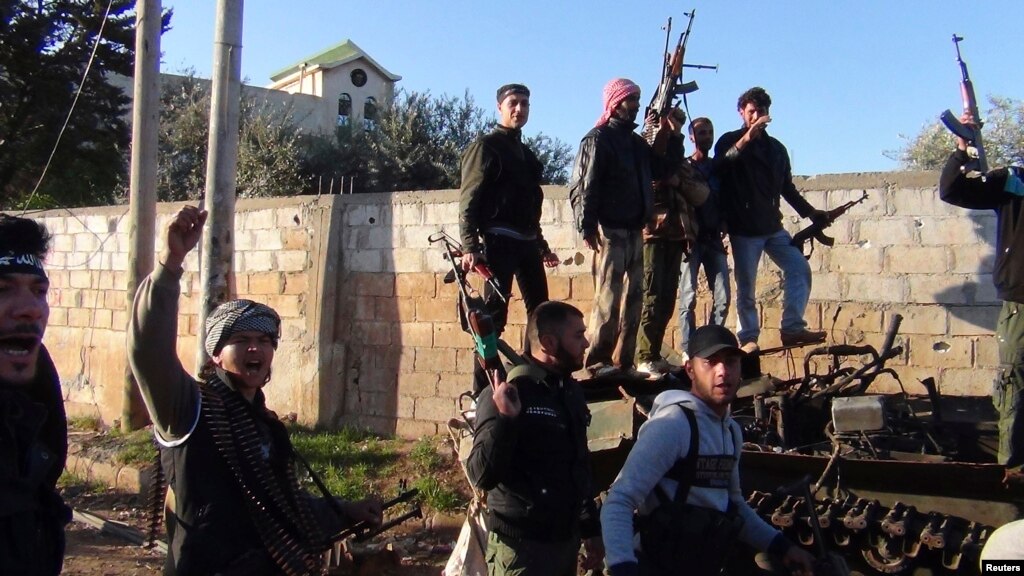
Free Syrian Army fighters cheer after saying they seized the al-Yadoudeh government checkpoint in al-Yadoudeh area in Deraa March 24, 2013.


RELATED ARTICLES

Iran, Syria, NKorea Block Global Arms Treaty
Lawlessness Spreading in Rebel-held Syria
Mortars Kill 15 Students at Damascus University
Syrian Refugees Seek Dangerous New Routes to Safety in Jordan

VOA News

March 29, 2013
Syrian activists say rebels captured a strategic town near the border with Jordan Friday, as the opposition continues its advance in the south.

The British Observatory for Human Rights says rebels forced most government troops out of the town of Dael in Daraa province following 24 hours of deadly battles. At least 16 rebels and several others were killed in the fighting.

The area, which has seen renewed clashes, serves as an important gateway to the capital, Damascus. The Observatory also said fighting broke out Friday in areas surrounding the capital, including Qaboon and Yarmuk.


Cl
It comes a day after mortar fire killed as many as 15 students at Syria's Damascus University. State media blamed the attack on the opposition. Opposition activists also reported the bombing, but did not say who was responsible.

The two-year-old civil war, which began as a peaceful uprising against the government of President Bashar al-Assad, has killed at least 70,000 people.

Sunday, March 24, 2013

Musharraf heads back to Pakistan despite threats


Musharraf heads back to Pakistan despite threats

Gen Musharraf has tweeted a photo of himself aboard the plane
Continue reading the main story
Related Stories
Profile: Pervez Musharraf
Musharraf delays Pakistan return
Musharraf vows return to Pakistan

Former Pakistani President Pervez Musharraf has left Dubai on a plane to Karachi, ending his self-imposed exile and defying death threats.

He said the Taliban had tried and failed to kill him, adding that he was taking precautions because his safety could not always be guaranteed.

General Musharraf plans to lead his party in the May general election.

Meanwhile, 17 soldiers were killed by a suicide bomber in north-west Pakistan overnight.

They were attacked at a security checkpoint in the tribal region of North Waziristan, close to the Afghan border and a known stronghold of the Taliban and al-Qaeda-linked militants.

A recent Taliban video threatened Gen Musharraf with snipers and suicide bombers.

He faces a string of charges including conspiracy to murder, but on Friday the Pakistani authorities granted him protective bail in several outstanding cases, freeing him from immediate arrest once he steps foot in Pakistan.'Like a wedding party'

The former leader tweeted a photo of himself aboard the plane, writing: "Settled in my seat on the plane to begin my journey home. Pakistan First!"

On the way into the airport, the smiling general told the BBC's Orla Guerin it felt like a wedding party.

A group of about 200 supporters and journalists are travelling with the former military ruler - including party members from the UK, Canada, Switzerland and the US.

Before take-off chants of "Long live Pervez Musharraf" broke out on board, says our correspondent.

Some of the general's supporters wore white armbands saying they were ready to give their lives for him.

But aides confirmed a planned mass rally had been called off because authorities withdrew permission. Instead, they said, a rally would be held at the airport in Karachi upon arrival.

The former military leader has lived in London and Dubai since stepping down five years ago.

He has vowed to return several times in the past, but those previous attempts have been abandoned.

Monday, March 18, 2013

"The Bible": Does Satan look like Obama in History Channel miniseries?

CBS NEWS/ March 18, 2013, 12:22 PM

"The Bible": Does Satan look like Obama in History Channel miniseries?

Mohamen Mehdi Ouazanni as Satan in the TV mini-series "The Bible." / HISTORY CHANNEL

The History Channel miniseries "The Bible" has been a hit in the ratings, but it's also grabbing attention because of the actor playing Satan -- and the public figure some viewers think he resembles.

After actor Mohamen Mehdi Ouazanni's first appearance as Satan in "The Bible" aired on Sunday, a number of viewers took to Twitter to say that he bears a resemblance to President Barack Obama.

Pictures: The Bible on screen
"The Bible": How a hit TV miniseries was born


One person who took notice was conservative commentator Glenn Beck, whotweeted on Thursday, "The bible on the history channel Sunday. Best episode yet. Don't miss it. Does satan look EXACTLY like Obama? Y e s!"

Then over the weekend he tweeted:

Best episode yet this Sunday. One of the most important shows in decades #TheBibleinsidetv.ew.com/2013/03/06/mar...— Glenn Beck (@glennbeck) March 16, 2013


Play VIDEO
Making TV's "The Bible"


Ouazanni has appeared in several other biblically-themed productions, including the TV movies "The Ten Commandments," "In the Beginning" and "David."

"The Bible," created by reality show producer Mark Burnett ("Survivor," "The Voice") and his wife, actress Roma Downey, drew 13.1 million viewers when it premiered earlier this month, making it cable's most-watched entertainment telecast of 2013. The 10-hour miniseries concludes on Easter Sunday.© 2013 CBS Interactive Inc. All Rights Reserved.

Friday, March 8, 2013

Zinat Karzai, Afghanistan's 'invisible' first lady


Zinat Karzai, Afghanistan's 'invisible' first lady

Zinat Karzai is qualified as a doctor and worked for years in Pakistan before her marriage
Continue reading the main story
Related Stories
Zinat Karzai: An invisible first lady?Watch
Profile: Hamid Karzai

She has been called Afghanistan's invisible first lady. Zinat Karzai, the 43-year-old wife of Hamid Karzai, is rarely seen in public, prompting criticism that she is not doing enough to further the cause of women's rights in her country. This week she gave a rare interview to the BBC's Maryam Ghamgusar and Freba Zaher.

"Thank you and welcome," says a smiling Zinat Karzai greeting the BBC team in her modest, light-filled sitting room. "I'm very pleased to have you here."

Afghanistan's first lady lives behind a formidable barrage of security in the presidential palace in central Kabul.

It took five security checks, each more rigorous than the one before, to reach the ground-floor apartments which are currently home to her, her husband and their two young children.Security constraints

It is clearly a situation which poses big challenges to everyday family life.
Continue reading the main story
The women in Afghanistan's political families


BBC Persian TV interviewed three other Afghan women connected to powerful families to understand how they cope with life in the public eye of a conservative nation.

Waheeda Mohaqeq, 37, third wife of the Hazara leader and resistance fighter Mohammad Mohaqeq lives with him, their six children and his two other wives and all "get on very well together".

She has a degree in literature but says, "I'm a housewife and I like living a simple life. I'm happy that I can live just like any normal person, going out, going shopping. This is how I want it to stay."

Fatana Gillani, is the head of the Afghan Women's Council and married to MP Ishaq Gillani.

She is one of the few wives of prominent Afghan politicians who has a career of her own. The couple have been the target of much criticism from conservative Afghans because of her public profile.

Her charity provides support to a network of 500 under-privileged women.

"The oppression that Afghan women are subjected to now is like what was happening in the dark ages before Islam. There is still so much to do," she said.

Princess India (pictured above), 83, is the daughter of former King Amanullah, a moderniser who was deposed in 1929. She grew up in Rome.

Her mother was Queen Soraya, the first Afghan woman not to wear the veil. Her mother's glamorous modern fashion sense was hugely shocking to conservative Afghans at the time, and still would be for many people today today.

"One important thing that needs to happen is that Afghan men need to be educated. I'm sorry to say it, but Afghan men just don't have good manners. They need more education," she says.

"It's very, very difficult… to be constantly under guard all the time," she says. "I would prefer it if I could live outside the palace."

The security constraints are one reason why this intelligent and articulate woman rarely appears in public .

"I have not travelled to anywhere inside Afghanistan," she says. Instead, people come to her.

"I have lots of contact with ordinary Afghan women… involved in areas like politics, social affairs, education and healthcare. They often come to see me and share their thoughts."

Zinat Karzai's lack of visibility has prompted criticism from some Afghans, especially the younger generation, that she is not doing enough to stand up for women's rights and to set a positive example.

All the more so, her critics say, because she is a qualified doctor who before her marriage worked for some years in Pakistan.

"I know [my contribution] is not open and visible in the media," she says firmly. "But I've done what I can and what I know it's possible to do given the current circumstances in Afghanistan."

When she talks about current circumstances, Mrs Karzai is not just talking about security issues.

Her role is clearly also constrained by cultural sensitivities. She says the country is simply not ready for a high-profile first lady appearing at her husband's side.

"I think more time is needed," she says. "This country has suffered from more than 30 years of war. We need to fix everything gradually, and work in line with our culture and traditions."

Those traditions include the belief still held by many conservative Afghan Pashtun men that it is shameful for their wives to be seen by other men.

In fact, her own husband has been accused of having just such concerns. But she says it is her decision, not his, to keep out of sight.

"He and I both know our country's culture, traditions and the current state of affairs," she says tactfully. "We need to take this into account and to work in accordance with this."

Despite being out of the public eye, Zinat Karzai has met a number of other visiting first ladies.
Continue reading the main story
"Start Quote


All of us went through higher education. It was important for our family"Zinat Karzai

She numbers Cherie Blair, Laura Bush and Gursharan Kaur, the wife of Indian Prime Minister Manmohan Singh, among the first ladies she admires. She is also close to Iranian President Ahmadinejad's wife, Azam al-Sadat Farahi, whom she speaks to on the telephone.

Zinat and Hamid Karzai have been married for 14 years, and since she became first lady she has had two children.

Her son Mirwais is now six, and she has a baby daughter called Malala.

She says President Karzai dotes on the children, although he struggles to make time in his packed schedule to spend time with them.

"Sometimes, perhaps on Fridays, he might be free for an hour or so," she says, "so he will go for a walk with me and the children. We all go out together - once in a while."

President Karzai has in the past spoken emotionally about the kind of Afghanistan he hopes his son will grow up in.

For many Afghan families, a daughter is seen as less valuable, but Zinat says President Karzai is equally ambitious and hopeful for his daughter.Fashion conscious

"For us… there is no difference between a boy and a girl," she says. "A daughter is the best gift from God."

Like her husband, Zinat Karzai has a keen eye for clothes and has cultivated what she calls an Afghan style of dress.

For the BBC interview she was wearing a light green long dress and matching head scarf.
The president usually attends public occasions unaccompanied by his wife

While for many outsiders the burka is a symbol of the lack of freedom many Afghan women still experience, Mrs Karzai maintains that it is not actually part of Afghan tradition at all.

"The burka… is imported from abroad," she says. "In rural areas the majority of women just wear a big headscarf. This is Afghan dress."

Looking back to her own childhood, Zinat Karzai remembers with affection her father who worked in the education ministry and pushed all his daughters to study.

"My parents… made sure that me and my sisters all got an education and went to university," she says. "All of us went through higher education. It was important for our family."

Although she feels unable to play a greater role in public life, Mrs Karzai says she is keen for both her children to be educated in Afghanistan, and maybe, if they are interested, even to go into politics.

"Their father has done so much for this country," she says. "It would be good if they could also serve their country."

Wednesday, March 6, 2013

Egypt court suspends April general elections


Egypt court suspends April general elections

Egypt has been wracked by political tension for months

Egypt changing
Q&A: Riots and political crisis
President tested
Mubarak legacy
Black Bloc anarchists emerge

An Egyptian administrative court has suspended general elections that were scheduled to begin next month.

It said the electoral law needed to be reviewed by the Supreme Constitutional Court to determine whether it conformed to the constitution.

President Mohammed Morsi had said the polls would begin on 22 April, taking place in four stages over two months.

The elections have been boycotted by the main opposition, amid continuing street protests.

The National Salvation Front (NSF) has said the electoral law favours Mr Morsi's Islamist allies - a claim denied by the president.

The NSF has also expressed concerns that the election will not be free and fair.

Egypt remains sharply divided between Islamists and their liberal and secular opponents.

More than 70 people have been killed in violence between security forces and protesters since February, following the second anniversary of the revolution that ousted President Hosni Mubarak.

On Wednesday, the security head in the city of Port Said was dismissed following renewed clashes between demonstrators and police.

The coastal city has seen sporadic violence since January, when death sentences were handed down to 39 people imprisoned over football violence last year which left more than 70 people dead.Further complication

The administrative court said it had acted because the Shura Council - the upper house of parliament - had not returned the amended electoral law to the Supreme Court for final review.

Instead, the court said, the Shura Council had sent the law to President Morsi for ratification.

Mr Morsi's office has so far made no public comment on the court's decision. The president can appeal against the ruling.

Egyptian courts have made a number of decisions that have gone against the president and his Muslim Brotherhood movement, further complicating the country's political crisis.

In June, the lower house was dissolved after the Supreme Constitutional Court ruled that one of the laws under which the elections were fought was not legitimate.

In the last elections, in January 2012, Islamist parties won an overwhelming majority, with the Freedom and Justice Party of the Muslim Brotherhood movement taking the biggest share

UK to send armoured vehicles to Syrian opposition


UK to send armoured vehicles to Syrian opposition


Foreign Secretary William Hague: "The cabinet is in no doubt that this is necessary"

Syria conflict
Frustration forces Western shift
Hiding underground to escape
Living in a battleground town
Low hopes for Rome talks

The UK is to provide armoured vehicles and body armour to opposition forces in Syria "to help save lives", Foreign Secretary William Hague has said.

It will offer millions of pounds in "non-lethal" equipment, including search and rescue, communications, and disease-prevention materials.

Mr Hague said it was a "necessary, proportionate and lawful" response to "extreme human suffering".

But some MPs said they feared being drawn into a military intervention.

Up to 70,000 people have been killed and a million refugees have fled since the crisis began two years ago.

The latest UN figures show that two million have been internally displaced, while 400,000 have fled abroad since the start of the year, with the largest number seeking shelter in Jordan, Lebanon, Turkey, Iraq and Egypt.Iraq fear

UN High Commissioner for Refugees Antonio Guterres has warned that Syria was "spiralling towards a full-scale disaster" and that international response capacity was "dangerously stretched".
Continue reading the main story
Analysis
Jonathan MarcusDefence and diplomatic correspondent

The Foreign Secretary William Hague set out why the crisis in Syria mattered to Britain: The dangers of the growth of jihadist extremism; the risks to peace in the wider Middle East; and the scale of the humanitarian suffering.

Britain though is still not ready to supply arms to the Syrian opposition. There will be assistance, advice and training to help maintain security in areas already controlled by the opposition.

Four-wheel drive armoured vehicles might be supplied to help opposition leaders move around.

This all marks a significant shift in British policy but one that, given the scale of the crisis on the ground, still falls far short of the weaponry that the Syrian opposition wants.

But Mr Hague made it clear that Britain's policy was not static and the direction in which it is heading, he hopes, will send a clear message to the regime in Damascus.

Mr Hague told Parliament the Syrian people were in "dire need" of help and the UK could not "look the other way" in the face of the escalating humanitarian crisis and what he said were human rights violations by the government of President Bashar al-Assad.

As the tenth anniversary of the Iraq war approaches, Lib Dem Sir Menzies Campbell said many MPs were concerned "lest we might drift towards" military intervention in Syria.

Although Mr Hague refused to rule out the possibility in the future, he said: "No Western government is advocating military intervention of Western nations into the conflict in Syria. The discussion is entirely focused on the degree of assistance that can and should be delivered to the opposition."

He announced a £13m package of logistical and humanitarian support for areas under opposition control which he said was possible after changes to the terms of the EU's arms embargo - permitting the supply of a wider range of non-lethal assistance - last week.

The UK will provide non-combat armoured vehicles to opposition forces to help them move around in safety, as well as body armour. Other material being provided includes communications and refuse collection equipment as well as support for the electricity grid and water supply.

Testing equipment to provide evidence of any use of chemical weapons will also be supplied, Mr Hague added, as there was a risk that such weapons could be used against Syrian civilians.'Carefully monitored'

"The Cabinet is in no doubt that this is a necessary, proportionate and lawful response to a situation of extreme humanitarian suffering, and that there is no practicable alternative," he said.

"All our assistance will be carefully calibrated and monitored as well as legal, and will be aimed at saving life, alleviating this human catastrophe and supporting moderate groups."


FSA commander Gen Selim Idriss says Syrian rebels need arms and ammunition

The move follows the US government's pledge of £40m in non-lethal assistance last week and signs that the international community may be reconsidering its policy of not providing military support to groups opposed to the Assad government.

The commander of the Free Syrian Army, General Idriss, who defected from forces loyal to President Assad last year, told the BBC opposition forces desperately needed weapons and ammunition and called for the EU arms embargo to be lifted.

During a visit to the the European Parliament, he said fears that weapons supplied to the opposition would end up in the wrong hands were misplaced and insisted that jihadist groups had no chance and no role in the future of Syria.

Mr Hague, who claimed Iran was increasing its support for the government, made clear the UK was not considering arming opposition forces but would provide "assistance, advice and training" to them and could not rule out further support if the situation worsened further.

"In our view, if a political solution to the crisis in Syria is not found and the conflict continues, we and the rest of the EU will have to be ready to move further, and we should not rule out any option for saving lives."

Several MPs expressed concerns that the UK was not putting enough effort into trying to secure a diplomatic solution to the crisis.'Neo-con policies'

Former Conservative defence minster Sir Gerald Howarth said he feared the UK's "hand is being drawn ever closer into this mangle", while fellow Conservative Bob Stewart urged the foreign secretary to put all his efforts into securing a ceasefire so politics, not the military could solve the situation.

Labour's Peter Hain said there had been "a monumental failure of diplomacy" and accused Mr Hague of "making the situation worse". He called for President Assad's offer of negotiations to "be tested to destruction".

Conservative Edward Leigh urged Mr Hague to reject the "neo-con policies" of those called for the UK to arm the rebels. "What is wrong with basing our policy on life and not death?" he asked.

And some MPs expressed concerns that equipment could fall into the hands of extremist groups and jihadists whose interests were not aligned with the UK.

Labour said the worsening situation was an indictment of the international community's failure to act collectively and decisively.

Shadow foreign secretary Douglas Alexander said: "It is right that efforts must now intensify but the key issue is the breadth of these efforts, how these efforts are channelled and how likely they are to deliver some results.

"There are some vital areas where the international community must better co-ordinate and target its efforts.

Monday, February 18, 2013

BNP criticise Churches for supporting Oswestry Islamic Centre bid


BNP criticise Churches for supporting Oswestry Islamic Centre bid


The Oswestry and Border Counties Advertiser follows its report last week, on the planning approval granted by the local council to the Oswestry Muslim Society for converting a 19th century Presbyterian church into an Islamic centre


with news of the BNP's criticism of local churches for supporting the plans.

Phil Reddall, who stood as the BNP's parliamentary candidate in the 2010 general election, told the local the paper:

"Churches Together are creating a monster by giving their backing to the scheme and this is another example of the political establishment appeasing the Muslim community despite disenfranchising our own community at the same time."

Reddall added that the BNP intends to "step up its leafleting campaign in the run up to May's local elections" saying that support for the party "has grown in Oswestry more than any other North Shropshire town since 2009."

He said:

"In 2009 a BNP candidate stood in College Ward and received 15 per cent of the vote. This is an issue we can run with again and a surprising amount of people agree with us when we speak to them."

Local elections are to be held in parts of England on Thursday 2nd May. Details of councils where seats will be contested are available on the Electoral Commission website, here.

Northumbria Police braced for SDL demo tomorrow


Northumbria Police braced for SDL demo tomorrow


The Berwick Advertiser reports on steps being taken by Northumbria Police ahead of the Scottish Defence League's demonstration in Berwick tomorrow, Saturday 16th.


The local paper notes that "Posts on a Facebook group under the [SDL] branch's name contain a series of anti-Islamic references and seek to drum up support for the Berwick event.

"In response to the planned march, new group Berwick United Against Fascism has formed, and arranged a demonstration of its own at 12 noon in the town centre.

"Northumbria Police has said it will have an increased presence in the town on Saturday when members of both the Scottish Defence League and Berwick United Against Fascism descend on the town."

Estimated costs to the public purse of policing some of the EDL/SDL demonstrations in recent months include £800,000 for a demonstration in Manchester in January, and £100,000 for a demo in Norwich last December. An EDL demonstration held in Bristol last summer required the presence of 700 police officers at a cost of almost £495,000.

The Metropolitan Police Service claimed it was 'unable' to calculate the cost of policing EDL protests and counter protests in Walthamstow, East London last year in the months September and October after a Freedom of Information request was put in by a local paper.

Tuesday, February 12, 2013

Deputy mayor calls meeting to discuss anti-Muslim abuse in Bingham


Deputy mayor calls meeting to discuss anti-Muslim abuse in Bingham


BBC News reports that the Deputy Mayor of Bingham, Nottinghamshire, Francis Purdue-Horan, has called a meeting of local officials following news reports of thesystematic abuse suffered by a Muslim family in the town.


Murad Alam, in an interview with BBC Asian Network last week relayed the extent of abuse suffered by his family and its prompting them to move to another area.

Deputy Mayor, Purdue-Horan, who has called for the meeting this week told the BBC, "The town council will work with various other agencies to work together to address anything that may need to be looked at in the future but that's more of a long-term issue, if anything is identified".

"I don't think that Bingham or Rushcliffe has a serious problem, but let's wait and find out."

The BBC notes that when Mr Alam "tried to inform Bingham Town Council after the first attack in November last year, they did "not seem very interested" and his call was not returned."

Three in court accused of throwing bacon at Edinburgh mosque

Three in court accused of throwing bacon at Edinburgh mosque


The Scotsman newspaper reports on the court appearance of three people charged with a racially prejudiced offence after bacon was thrown at Edinburgh's Central Mosque.

The paper reports that the three individuals, Douglas Cruikshank, 37, Chelsea Lambie, 17, and Wayne Stilwel, 24, have been released on bail with the special condition that they do not go within 100 metres of any mosque.

"It is alleged the Central Mosque, in Potterrow, had bacon thrown at it and stuck to certain parts of the building on January 31," according to the paper.

Enfield Tory councillor suspended for anti-Muslim Facebook comments


Enfield Tory councillor suspended for anti-Muslim Facebook comments


Local paper, the Enfield Advertiser, covers news published in the Guardian on Saturdayon the suspension of a Tory councillor in Enfield for posting anti-Muslim comments on Facebook.


Chris Joannides, who has since deleted his Facebook page, posted the remark, "I saw her standing there and I told her she had three beautiful children. She didn't have to get all pissed off and threaten me … an honest mistake," next to a picture of a woman and child dressed in burqas with bin bags beside them.

Enfield Conservative group leader Michael Lavender has since suspended the councillor from the party while further disciplinary action is considered.

The incident will be of some embarrassment to Tory HQ. The party is purportedly planning an ethnic minority charm offensive in an attempt to secure a parliamentary majority at the next election.

Tuesday, February 5, 2013

Corruption Undermining Democracy in Europes

LETTER FROM EUROPE

Corruption Undermining Democracy in Europe

By JUDY DEMPSEY


Since the fall of Communism, the council has become, in effect, the first way station for former Soviet bloc nations aspiring to join a web of Western alliances.

As a result, some council members, notably Central Asian states and Russia, have tried to influence the organization's parliamentary assembly with lavish gifts and trips, Mr. Jagland said. They also hire lobbyists to fend off criticism of their human rights records.

"Kicking these countries out is not an option," Mr. Jagland said in an interview. "The council is introducing new rules about what kind of gifts should be given. If political bodies want to combat corruption, then we have to start with ourselves."

Mr. Jagland, a Norwegian who also heads the committee that awards the Nobel Peace Prize, knows that corruption damages the council's reputation. Worse, he believes that corruption has an insidious impact on political institutions and democracy itself.

"It is the biggest threat to democracy in Europe today. It undermines citizens' trust in the rule of law," he said, mentioning his own Norway, and Finland, both perceived as bastions of integrity yet both now embroiled in corruption scandals.

Has corruption really become so prevalent that it demands campaigns and new agencies to combat it?

"I don't think the corruption was less a few years ago than it is today," said Alina Mungiu-Pippidi, director of the European Research Center for Anti-Corruption at the Hertie School of Governance in Berlin.

The European Union, for example, knew that funds earmarked for improving infrastructure were misappropriated in many of the 27 member countries, she argued. In many cases such abuses were tolerated.

The euro crisis, however, seems to have changed public attitudes.

Because of the austerity measures in Greece, Ireland, Portugal and Spain, voters there are no longer prepared to tolerate corruption. They want an end to the kickbacks, undeclared taxes or overseas bank accounts held by politicians — for decades a routine way to conduct business and politics, particularly in Southern Europe.

Above all, Dr. Mungiu-Pippidi argued, they want transparency and accountability.

According to a recent study by the European Commission, the European Union's executive body, nearly three-quarters of citizens in E.U. states perceive corruption as a major problem in their own countries. More than half believe it has increased in recent years.

"The euro crisis has made the public much more aware of abuse of public office," said Timo Lange, a leading member of LobbyControl, an independent organization that monitors lobbyist groups and how they influence the way lawmakers vote or how contracts are awarded.

"If voters do not see the political parties and governments taking measures to stop it, they will lose trust in the conventional political system," he added.

That is already happening.

Over the past few years, Europe has spawned many fringe political movements, anti-establishment parties and new nongovernmental organizations whose aim is to expose and combat corruption.

Mr. Jagland, however, sees another, more dangerous trend developing: a crisis of values.

"This crisis and sense of disillusionment in the political system is reflected in the rise of extremism and hate speech, new nationalism, vilification of immigration and any other forms of otherness," he said.

There is no shortage of measures adopted by the Council of Europe, the European Union, the World Bank and other institutions to combat corruption and promote good governance.

The Union itself — as befits Brussels' bureaucracy — has established a group to deal with these issues and is cooperating with the Council of Europe's Group of States against Corruption.

Dr. Mungiu-Pippidi believes these efforts fall short of what should be done. In her view, the institutions are timid and bureaucratic.

"The Council of Europe should name and shame," she says. "It should be much more outspoken in the defense of values and take a much tougher policy towards member countries that flout the rule of law and values of the council," she added.

The European Union's efforts are also hampered by its own structures. Even though the Union prides itself on exporting its values, Dr. Mungiu-Pippidi said the way it goes about this "is bureaucratic and nontransparent. It undermines good governance."

Instead, analysts say civil society movements and the news media are crucial in exposing corruption. "Of course, they can be intimidated by governments and businesses in all sorts of ways," Mr. Lange said. "But the euro crisis has shown that the public does want transparency and fairness. It is time politicians responded."

Judy Dempsey is editor in chief of Strategic Europe at Carnegie Europe. (www.carnegieeurope.eu)